


Table of Contents
The sight of a new crack in your basement wall or a door that suddenly refuses to latch can send a shiver down any homeowner’s spine. You may wonder if the house is just “settling” or if it is the first cry for help from a foundation under serious stress. For homeowners concerned about foundation failure signs in Michigan homes, this question has become more urgent than ever in 2026.
Your home is your single largest investment, and its foundation is the bedrock of that investment. Ignoring the subtle indicators of distress can lead to catastrophic damage and expensive repair bills. This guide provides a forensic look at why local climates are creating a perfect storm for property owners in Shelby Township, Troy, and across Metro Detroit.
Key Takeaways
- Climate Impact: The erratic freeze-thaw cycles of 2025-2026 are putting unprecedented stress on local foundations.
- Soil Factors: Southeast Michigan’s “Clay Bowl Effect” is the primary culprit behind hydrostatic pressure.
- Crack Identification: Horizontal cracks are a red flag for structural failure, while vertical cracks often indicate standard settling.
- Early Detection: Identifying house settling symptoms in Southeast Michigan early can save you thousands in excavation costs.
The Southeast Michigan Foundation Crisis: Why 2026 is a Turning Point
For decades, Michigan homeowners have understood that foundations move. However, 2026 is different. The winter of 2025-2026 brought a pattern of rapid freezing followed by sudden thaws and heavy rain. This erratic cycle caused groundwater levels across Oakland and Macomb counties to surge.
These conditions are pushing many homes past their breaking point. What might have been minor cosmetic issues are now escalating into structural damage indicators in Macomb County MI. We are seeing a clear shift toward critical risks that threaten structural integrity from Sterling Heights to Rochester Hills.
The Clay Bowl Phenomenon: Why Your Michigan Home is Under Pressure
To understand why foundation failure signs in Michigan homes are peaking, you must understand the soil. Most of our region sits on heavy clay. When a home is built, the backfilled soil around the foundation is looser than the undisturbed clay surrounding it. This creates a “bowl” that traps water directly against your foundation walls.
Clay soil swells when saturated and shrinks when dry. This cycle exerts lateral pressure on your basement. The intense rainfall of 2026 has supercharged this effect, which is one of the common causes of basements leaking in Southeast Michigan.
Sign 1: Horizontal Cracks vs. Vertical Cracking
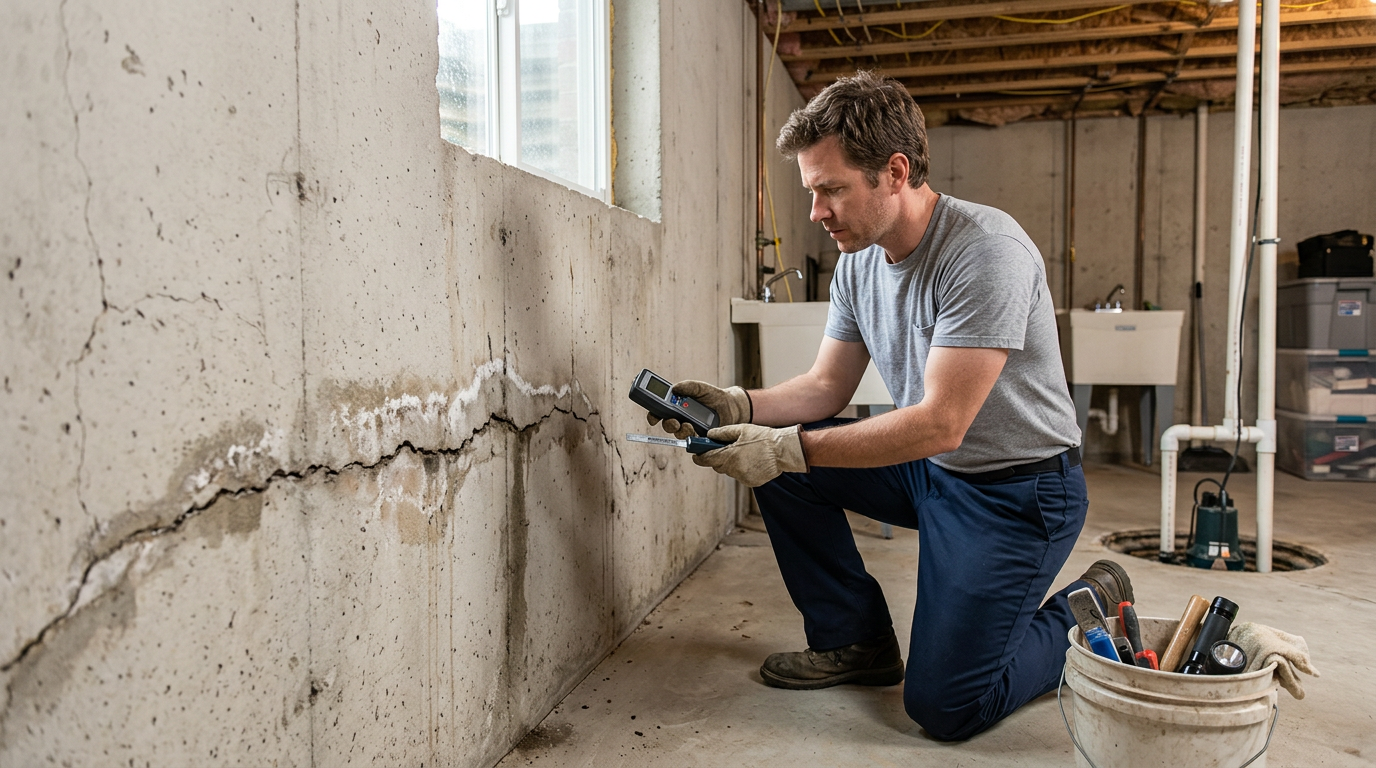
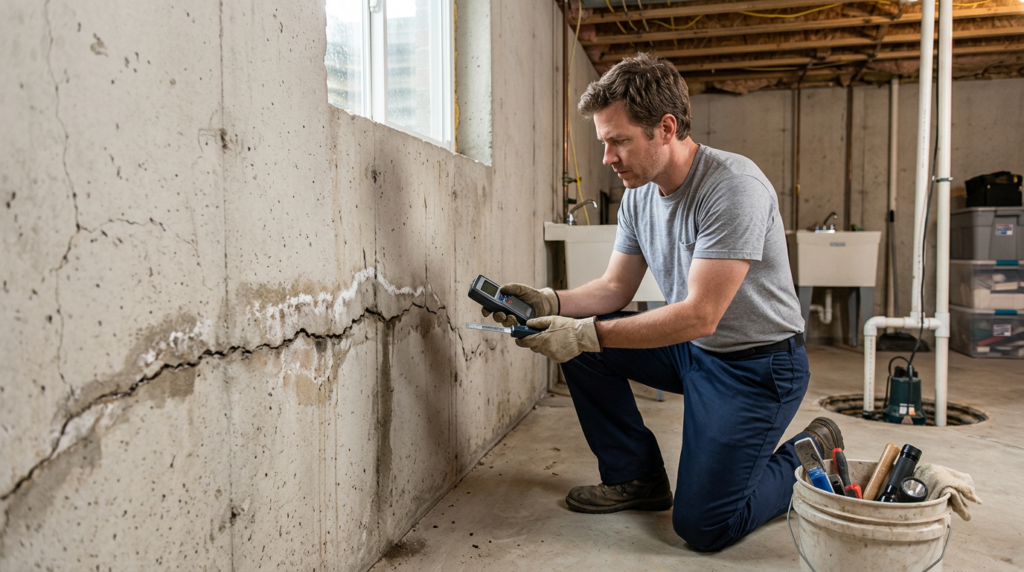
Vertical cracks are common and typically caused by uniform settling or concrete shrinkage. While they can cause leaks, they are not usually a sign of imminent failure. Horizontal cracks, however, are a major red flag. A horizontal crack in the middle third of a basement wall is a direct result of extreme hydrostatic pressure. For those needing foundation crack repair in Oakland County MI, identifying these early is vital.
| Severity | Characteristics | Recommended Action |
|---|---|---|
| Low | Thin vertical cracks (< 1/8 inch wide). | Monitor and consider sealing. |
| Moderate | Vertical cracks wider than 1/8 inch or fine horizontal cracks. | Professional evaluation and injection. |
| Critical | Horizontal cracks or stair-step cracks with bowing. | Urgent structural reinforcement required. |
Sign 2: Stair-Step Cracks in Brickwork in Troy MI
The signs of foundation failure are not confined to the basement. “Stair-step” cracks follow the pattern of mortar joints in exterior brick or concrete block walls. These are a classic “canary in the coal mine” for differential settlement—where one corner of the foundation sinks faster than the rest. We see these stair-step cracks in brickwork in Troy MI and Bloomfield Hills frequently due to the age of the local architecture.
Sign 3: Bowing Basement Walls in Michigan
A bowing wall is a foundation wall bending inward under soil pressure. If you stand at one corner and look down the wall, you may see a visible curve. Any deflection over one inch is a serious concern. Bowing basement walls in Michigan can often be stabilized with carbon fiber straps if caught early, preventing the need for exterior waterproofing and full excavation.
Sign 4: Uneven Floors and Sticking Doors
While many think of settling, Michigan’s clay can also cause “heaving.” This happens when soil absorbs moisture and pushes the concrete slab upward. Look for house settling symptoms in Southeast Michigan such as:
- Sticking doors and windows that refuse to latch.
- Gaps in crown molding or baseboards.
- New cracks originating from the corners of door frames.
Sign 5: Efflorescence and Spalling
Efflorescence is the white, chalky substance found on basement walls. It is a sign of mineral salts left behind by evaporating water. While it looks like mold, it actually indicates that water is slowly carrying away binding minerals from your concrete, leading to spalling (flaking) and weakened integrity.
Sign 6: Sagging Floors in Older Homes in Michigan
Many older residences in our area are built on crawl spaces. Increased groundwater levels in 2026 are turning these spaces into damp environments that rot wooden support beams. Sagging floors in older homes in Michigan are often paired with a musty odor, indicating the wooden skeleton of the home is compromised.
Sign 7: Exterior Grading and Frost Heave
When water in the soil freezes, it expands by 9%, creating “frost heave.” The 2025-2026 winter lacked consistent snow cover, allowing frost to penetrate deeper. If your yard slopes toward the house, it directs water into the clay bowl, where it freezes and shifts your foundation by inches during the spring thaw.
Professional Tip: Using thermal imaging inspections allows experts to find hidden moisture pockets behind finished walls without demolition, pinpointing issues before they become catastrophic.
The Cost of Inaction: Localized Impacts
Delaying a repair is the most expensive mistake you can make. A small crack that costs a few thousand dollars to stabilize today can become a $30,000+ rebuild in just a few years. Review our basement waterproofing cost guide for 2026 to see why early intervention is key.
Frequently Asked Questions About Foundation Failure Signs in Michigan Homes
1. Are small hairline cracks in my basement normal?
Small, vertical hairline cracks (less than 1/8 inch) are often due to concrete curing and are generally not a structural concern, though they can let in moisture. However, any horizontal crack, stair-step crack, or crack that is actively growing wider should be inspected by a professional immediately. For sealing minor leaks, professional foundation crack injection is often an effective solution.
2. How much does a foundation inspection cost in Southeast Michigan?
The cost can vary. Some companies offer a “free estimate,” which may just be a sales pitch. A true forensic assessment, involving detailed measurements and analysis, may have a fee, but it provides immense value by correctly diagnosing the root cause. At Mansour’s Innovations, we believe in providing a thorough evaluation; you can contact us for details on our comprehensive inspection process.
3. Can I fix my foundation myself?
DIY fixes are generally limited to cosmetic repairs like painting over small cracks or minor grading improvements. Attempting to repair structural issues like bowing walls without proper knowledge is dangerous and can make the problem worse. Structural repairs should always be left to licensed specialists familiar with Michigan soil.
4. What is the difference between foundation settling and foundation failure?
Settling is the natural, gradual sinking of a house as soil compacts. Foundation failure occurs when that movement becomes excessive or uneven (differential settlement), causing structural damage like major cracks and bowing walls. The signs in this article indicate a transition from normal settling to active failure.
5. How can I prevent foundation problems in my Michigan home?
The best defense is proactive water management. Ensure gutters are clean and downspouts extend 6-10 feet away from your foundation. For robust protection, a professionally installed system, whether interior or exterior, is the most effective way to combat hydrostatic pressure from clay soil.