


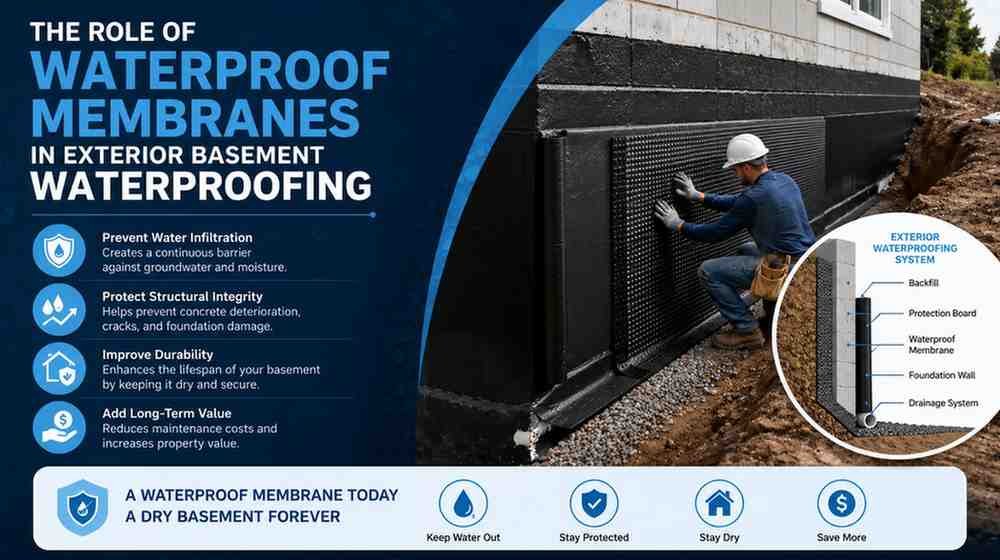
Basement foundations remain exposed to constant moisture from surrounding soil, rainfall, and groundwater. Without effective protection, water gradually penetrates concrete surfaces and creates conditions that encourage structural deterioration and interior dampness. Waterproof membranes serve as a critical barrier that blocks moisture before it reaches basement walls. Consequently, these systems improve foundation durability, reduce repair costs, and support healthier indoor conditions by controlling water at the exterior surface instead of managing it after infiltration occurs.
Why Does Exterior Waterproofing Matter?
Water always follows the path of least resistance, making basement walls especially vulnerable when surrounding soil becomes saturated.
Moreover, concrete contains microscopic pores that allow moisture migration even when visible cracks remain absent. Exterior waterproofing interrupts this movement by creating a protective shield around the foundation.
Preventing water entry at the source offers greater long-term protection than relying solely on interior moisture control methods.
What Is a Waterproof Membrane?
A waterproof membrane forms a continuous protective layer applied to the exterior surface of foundation walls before backfilling.
Its primary purpose involves preventing groundwater from reaching the concrete while maintaining flexibility under changing soil conditions. Consequently, the membrane shields structural components against moisture penetration throughout the life of the building.
Different membrane technologies provide varying levels of elasticity, durability, and resistance to environmental stress.
Primary Functions of Waterproof Membranes
These protective systems perform several important tasks.
- Block groundwater penetration
- Resist hydrostatic pressure
- Protect the foundation concrete
- Reduce moisture migration
- Improve basement durability
- Support drainage system performance
Each function contributes to maintaining a dry and stable basement environment.
How Waterproof Membranes Prevent Water Intrusion
Exterior membranes create an uninterrupted barrier that separates wet soil from foundation walls.
Furthermore, they prevent groundwater from entering concrete pores, cracks, and construction joints where seepage commonly begins. By stopping moisture before penetration occurs, membranes reduce the risk of interior leaks and long-term structural deterioration.
This proactive approach improves basement performance under varying weather conditions.
Common Types of Waterproof Membranes
Different construction projects require different membrane technologies.
Liquid-Applied Membranes
Liquid products create seamless coatings that conform closely to irregular wall surfaces.
Once cured, they form flexible barriers capable of accommodating minor foundation movement without losing waterproof integrity.
Sheet Membranes
Sheet membranes consist of manufactured waterproof layers bonded directly to foundation walls.
Their consistent thickness provides reliable protection while reducing installation variability across large surfaces.
Rubberized Asphalt Membranes
Rubberized asphalt combines waterproof performance with excellent flexibility.
Its ability to bridge small surface imperfections helps maintain continuous moisture protection even when slight wall movement occurs over time.
The Relationship Between Membranes and Drainage Systems
Waterproof membranes perform best when paired with effective drainage components.
Foundation drains collect groundwater while membranes prevent direct wall contact. Consequently, hydrostatic pressure decreases because water moves toward drainage pipes instead of accumulating beside the structure.
Working together, these systems create multiple levels of moisture protection rather than depending on one barrier alone.
Hydrostatic Pressure and Foundation Protection
Hydrostatic pressure develops when saturated soil pushes against basement walls.
Over time, this force increases the likelihood of seepage, cracking, and structural stress. Moreover, prolonged moisture exposure accelerates concrete deterioration if protective measures are absent.
Waterproof membranes reduce these risks by blocking direct moisture contact and supporting efficient groundwater management around the foundation.
Drainage Boards and Membrane Performance
Drainage boards often complement waterproof membranes during exterior waterproofing projects.
These molded panels create vertical channels that direct water downward toward footing drains while shielding membrane surfaces from backfill pressure.
Benefits include:
- Improved water movement
- Reduced hydrostatic pressure
- Added membrane protection
- Better long-term durability
- Enhanced drainage efficiency
Together, drainage boards and membranes strengthen exterior moisture defense.
Surface Preparation Before Membrane Installation
Proper preparation significantly affects waterproofing performance.
Foundation walls require cleaning, smoothing, and repair before membrane application. Cracks, voids, and irregular surfaces should receive correction to ensure continuous adhesion across the entire wall.
Careful preparation minimizes weak points that could compromise waterproof integrity after backfilling.
Installation Quality Influences Long-Term Results
Even premium waterproof materials depend on proper installation techniques.
Uniform coverage, sealed overlaps, protected corners, and complete adhesion prevent moisture pathways from developing beneath the membrane. Consequently, installation quality directly affects long-term basement protection.
Attention to detail during construction often determines whether waterproof systems perform successfully for decades.
Flexibility Supports Lasting Protection
Foundations experience minor movement caused by settlement, temperature changes, and seasonal soil expansion.
Flexible membranes accommodate these shifts while maintaining waterproof continuity. In contrast, rigid coatings may crack under movement, creating openings that permit moisture penetration.
Material flexibility therefore contributes significantly to long-term exterior waterproofing performance.
Resistance to Soil Chemicals and Environmental Conditions
Exterior waterproof membranes remain exposed to challenging underground conditions.
Manufacturers design advanced materials to resist soil minerals, moisture, biological activity, and temperature fluctuations without rapid deterioration. Consequently, quality membranes maintain protective performance despite prolonged contact with aggressive environmental conditions.
Durable construction materials reduce maintenance demands and improve overall system longevity.
Choosing Membrane Systems for Different Soil Types
Soil characteristics influence waterproofing performance.
Clay retains water and increases hydrostatic pressure, while sandy soil drains more rapidly but may shift during settlement. Therefore, membrane selection should reflect local ground conditions to maximize durability and moisture resistance.
Projects involving exterior basement waterproofing Michigan properties often consider seasonal freeze-thaw cycles and varying groundwater conditions when selecting flexible membrane systems capable of maintaining reliable long-term protection.
The Importance of Proper Seam Sealing
A waterproof membrane performs effectively only when every joint and transition remains sealed.
Corners, pipe penetrations, wall intersections, and overlap areas require careful attention during installation. Consequently, complete seam protection prevents moisture from reaching the foundation through small gaps that could compromise the entire waterproofing system.
Continuous coverage creates a dependable exterior barrier that resists long-term water intrusion.
Critical Areas Requiring Extra Protection
Certain foundation sections demand additional waterproofing attention.
- Footing-to-wall connections
- Utility penetrations
- Window well openings
- Expansion joints
- Exterior corners
- Surface transitions
Protecting these vulnerable locations strengthens the overall moisture defense and reduces the chance of localized seepage.
How Waterproof Membranes Protect Concrete
Concrete appears solid, yet microscopic pores allow moisture migration over time.
Waterproof membranes isolate foundation walls from surrounding soil moisture before penetration occurs. Moreover, they reduce repeated wetting and drying cycles that contribute to gradual surface deterioration and cracking.
Limiting moisture exposure helps preserve structural strength while extending the service life of the foundation.
Supporting Indoor Air Quality
Exterior waterproofing benefits more than structural components.
Moisture entering basement walls raises humidity levels that encourage mold and mildew growth. Consequently, blocking groundwater at the exterior surface supports healthier indoor conditions and reduces unpleasant odors associated with damp environments.
Dry basements also help protect stored belongings, insulation, and interior finishing materials from moisture-related damage.
Common Installation Mistakes to Avoid
Even high-quality membranes cannot compensate for poor installation practices.
Frequent mistakes include:
- Applying membranes to dirty surfaces
- Leaving gaps at overlaps
- Failing to repair wall defects first
- Damaging membranes during backfilling
- Omitting drainage protection boards
- Ignoring the manufacturer’s curing requirements
Avoiding these errors improves waterproof reliability and reduces the likelihood of future repairs.
Routine Maintenance After Installation
Although exterior membranes require little maintenance, periodic property inspections remain valuable.
Checking grading, drainage outlets, gutters, and downspouts helps prevent excessive water accumulation around the foundation. Furthermore, correcting drainage issues promptly reduces unnecessary hydrostatic pressure against waterproofed walls.
Preventive maintenance supports long-term membrane performance without requiring excavation.
Simple Maintenance Practices
Property owners can protect waterproof systems through routine care.
- Keep gutters free of debris.
- Maintain positive yard grading.
- Direct downspouts away from walls.
- Inspect sump systems regularly.
- Prevent standing water near foundations.
- Address drainage concerns promptly.
These straightforward actions complement membrane protection and improve overall basement performance.
Long-Term Financial Advantages
Exterior waterproof membranes help reduce repair expenses by preventing moisture problems before they develop.
Dry foundations experience less deterioration, lowering the likelihood of structural restoration and interior damage. Moreover, moisture prevention protects flooring, wall finishes, insulation, and stored belongings from costly replacement.
Investing in exterior waterproofing often produces lasting value through reduced maintenance and preservation of structural integrity.
How Waterproof Membranes Complement Structural Stability
Although membranes primarily block water, they indirectly support foundation performance.
Reduced moisture limits freeze-thaw deterioration, concrete weakening, and soil-related pressure changes surrounding basement walls. Consequently, structural components remain in better condition throughout changing environmental conditions.
A dry foundation generally performs more consistently than one exposed to continuous groundwater intrusion.
Integrating Waterproof Membranes With Modern Building Systems
Modern construction increasingly combines waterproof membranes with drainage boards, footing drains, insulation panels, and protective coatings.
Each component performs a specialized function while supporting the others. Therefore, integrated exterior systems manage groundwater more effectively than isolated waterproofing methods.
Layered protection also provides greater resilience during periods of heavy rainfall or elevated groundwater conditions.
Choosing Durable Materials for Lasting Results
Material quality significantly influences the waterproof system’s lifespan.
High-performance membranes resist punctures, chemical exposure, temperature fluctuations, and soil movement more effectively than lower-grade alternatives. Furthermore, durable materials maintain flexibility and adhesion over extended periods beneath challenging underground conditions.
Selecting reliable products supports consistent moisture protection for many years.
Conclusion
Waterproof membranes serve as one of the most effective defenses against basement moisture by creating a durable exterior barrier that blocks groundwater before it reaches foundation walls. Moreover, combining membranes with proper drainage and careful installation strengthens long-term structural protection while reducing interior water damage risks. Regular maintenance and thoughtful material selection further improve performance, allowing foundations to remain dry, stable, and resilient despite changing environmental conditions and ongoing exposure to underground moisture.
FAQs
1. What is the primary purpose of a waterproof membrane?
A waterproof membrane prevents groundwater from contacting foundation walls by forming a continuous exterior barrier. Consequently, it reduces moisture penetration, limits hydrostatic pressure effects, and protects concrete from long-term deterioration caused by repeated exposure to wet soil.
2. How does a waterproof membrane differ from a damp-proof coating?
Waterproof membranes resist continuous water pressure and block groundwater intrusion, while damp-proof coatings mainly slow moisture migration. As a result, membranes provide stronger protection for basements exposed to saturated soil and hydrostatic pressure around foundation walls.
3. Can waterproof membranes prevent basement leaks completely?
Properly installed membranes significantly reduce leak potential when combined with effective drainage systems and positive grading. However, overall performance depends on installation quality, maintenance, and controlling groundwater conditions surrounding the foundation throughout the property’s lifespan.
4. Why should drainage systems accompany waterproof membranes?
Drainage systems remove groundwater before pressure builds against basement walls. Consequently, membranes experience less stress, improving durability while reducing the chance of moisture intrusion through construction joints or structural imperfections beneath surrounding soil.
5. Are waterproof membranes flexible after installation?
Many modern membranes remain flexible after curing, allowing them to accommodate minor foundation movement caused by settlement or seasonal soil changes. This flexibility helps maintain waterproof continuity without developing cracks that permit water penetration.
6. Do waterproof membranes require regular replacement?
Quality waterproof membranes generally provide long service life when installed correctly and protected from physical damage. Routine maintenance of surrounding drainage systems helps preserve their effectiveness without frequent replacement or extensive excavation work.
7. Can waterproof membranes improve indoor basement conditions?
Yes. Preventing groundwater infiltration lowers humidity levels inside the basement, reducing mold growth, musty odors, and moisture damage to finishes and stored belongings. Dry conditions also support healthier indoor air and improved comfort.
8. What factors influence membrane durability?
Material quality, installation methods, soil conditions, drainage performance, and protection during backfilling all affect membrane lifespan. Careful construction and ongoing moisture management contribute to consistent long-term waterproof performance beneath ground level.
9. Why is surface preparation important before membrane application?
Clean, smooth foundation walls promote proper membrane adhesion and reduce weak points. Repairing cracks and imperfections beforehand creates continuous waterproof coverage that resists groundwater penetration more effectively after backfilling and soil settlement.
10. Can waterproof membranes increase property value?
Dry basements and protected foundations often improve buyer confidence because they indicate proactive maintenance and reduced moisture risk. Consequently, effective exterior waterproofing supports long-term structural preservation while contributing positively to overall property appeal and value.