


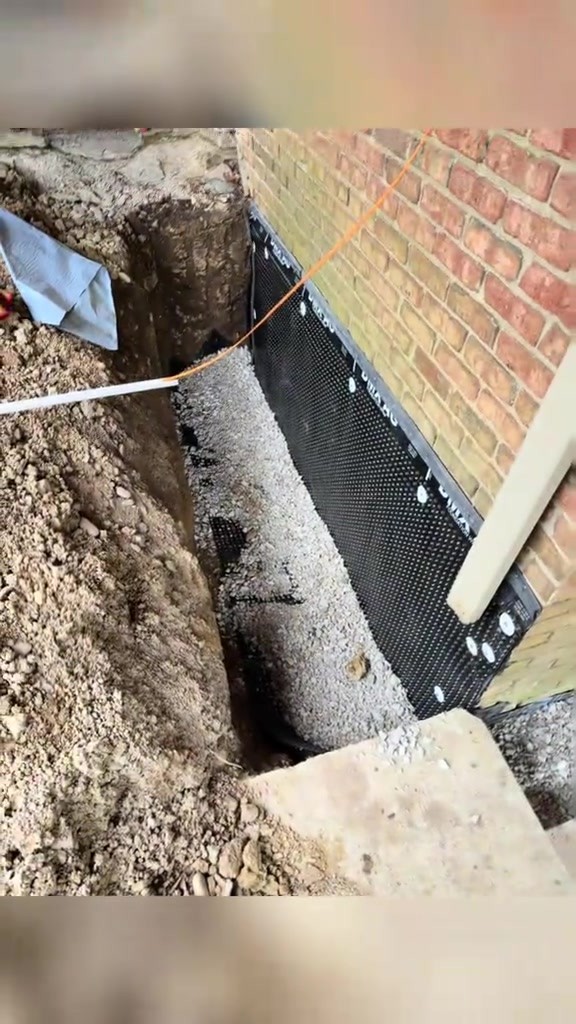
A basement wall that is bowing inward is the one foundation problem we tell people not to wait on. It does not leak much at first, so it gets ignored. But the force that pushed it in is still there, it pushes harder every wet spring and every freeze, and a wall that is an inch out of plumb today is not going to stay an inch. Here is what causes it, how to judge how serious yours is, and what the repair options are.
What causes a basement wall to bow
Soil pressure. Your foundation wall is a retaining wall holding back the dirt around the house, and three things make that dirt push harder:
- Saturated clay. Michigan clay swells when wet. A wall backfilled with clay (most of them) gets squeezed every spring and after every heavy rain, and the water in that clay adds its own hydrostatic pressure.
- Frost. Water in the top few feet of soil freezes and expands sideways into the wall. That is why the crack is so often at frost depth, a few feet below grade.
- Surface water. Downspouts dumping next to the house, grading toward the house, a driveway or patio that sheds water at the wall. More water in the backfill, more pressure.
Block walls bow more than poured walls because the mortar joints are the weak point: the wall hinges at a horizontal joint and leans in above it. Poured walls crack vertically and leak more than they bow. Our article on vertical vs. horizontal cracks covers the difference.
How to tell how bad it is
- Find the crack. A horizontal crack running along a mortar joint, usually 2 to 4 feet below grade, often with stair-step cracks running toward the corners.
- Measure the bow. Hang a plumb line or hold a 4-foot level against the wall. Measure the gap at the widest point. Mark the date on the wall next to it with a pencil.
- Check again in spring and fall. A wall that is moving needs attention sooner than one that bowed once years ago and stopped.
As a general guide: carbon fiber is for a wall that has only started to move, and steel I-beam braces are for a wall that is bowing or leaning more. We measure every wall before we recommend anything.
Repair options
Carbon fiber straps
Strips of carbon fiber fabric epoxied vertically to the inside of the wall, anchored at the top and bottom. They do not pull the wall back; they stop it from moving further. Nearly flat, paintable, no digging. Right for walls with a small, stable bow.
Steel I-beam braces
Steel beams set vertically against the inside of the wall, anchored into the floor and to the joists above. They hold a wall with more movement than carbon fiber can, so it does not keep coming in. They stick out into the room a few inches. Prices for both, and how we decide between them, are on our foundation repair page.
Exterior excavation: fix the cause
When a bowing wall also leaks along the crack, or in many places, the water can be stopped from the outside. We excavate along the wall to the footing, which takes the soil pressure off completely. Then we clean and repair the wall, apply a membrane and lay new drain tile at the footing. This is also exactly what exterior waterproofing is, and it can be done in the same job as the bracing. This West Bloomfield wall had water coming in along the side and back; excavation found the footing drain packed with mud:
And a 40-foot exterior repair in Davisburg, done from outside with no basement demolition:
What we do not do
We do not pier, underpin or rebuild foundations, and we do not do slab jacking. If a wall has sheared and needs to be rebuilt, or the house is settling (doors out of square, cracks in the drywall upstairs, a footing that has dropped), that is a structural contractor and an engineer, and we will tell you so instead of selling you braces.
Stop the pressure from coming back
Whatever repair you choose, the water that caused it has to be dealt with, or the braces are just holding a wall that keeps getting pushed. Downspouts extended well away from the house, grading sloped away, and a footing drain that actually drains. If the basement also leaks at the floor, an interior drainage system drops the water table at the footing. Our waterproofing work carries a 25-year transferable limited warranty; wall bracing isn’t covered by it and carries only the warranty its own contract or invoice states in writing.
Frequently asked questions
Is a bowing basement wall dangerous?
A small, stable bow is not an emergency but it will not fix itself. A wall that is still moving, leaning in more than a little, or sheared at a joint needs attention now.
What causes a horizontal crack in a basement wall?
Lateral pressure from saturated clay and frost pushing on the outside of the wall. The crack is where the wall hinged.
How much does it cost to fix a bowing basement wall in Michigan?
It depends on how far the wall has moved and how much of it needs reinforcing. Our foundation repair page has the price ranges for carbon fiber and steel I-beam braces. We quote after measuring, and the estimate is free.
Can a bowed wall be straightened?
Carbon fiber and steel I-beam braces hold the wall where it is, so it does not keep coming in. We measure your wall at the free estimate and tell you which repair fits.
Does homeowners insurance cover a bowing wall?
Almost never. Soil pressure and frost are considered wear and tear. See our article on what insurance covers.
Mansour’s Innovations is a family-owned waterproofing, excavation and plumbing contractor in Shelby Township, Michigan, serving Macomb, Oakland and Wayne counties since 2014. Owner Imad “Matt” Mansour has 20+ years in the trade and the crew has completed 1,600+ projects. Our waterproofing work carries a 25-year transferable limited warranty. Call or text (586) 345-7292 for a free estimate.