


Updated
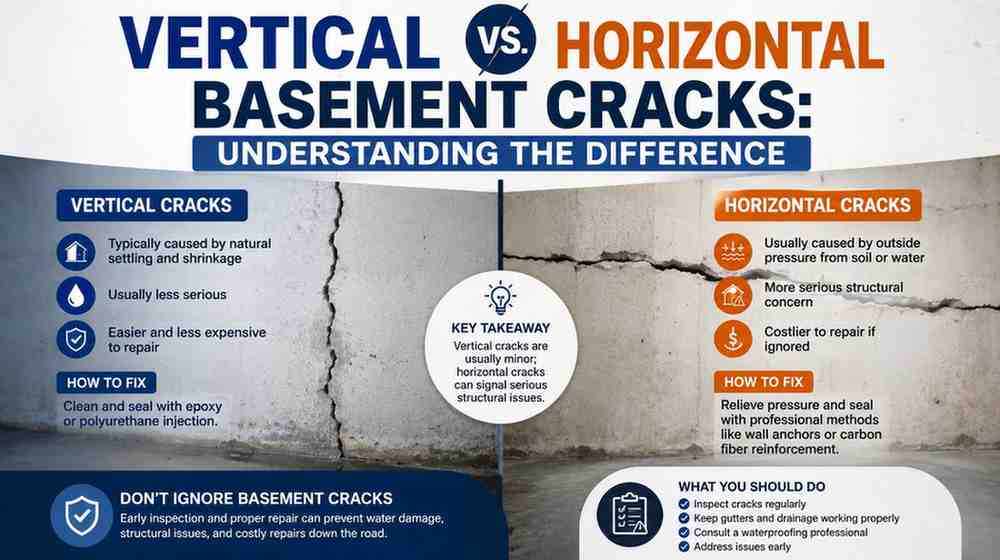
The direction a crack runs tells you a lot about what’s happening to your foundation. Some cracks are cosmetic. Some are leaks waiting to happen. One kind means the wall is moving. Here’s how to tell them apart.
Vertical cracks
Straight up and down, or close to it, usually in a poured concrete wall. Most come from the concrete shrinking as it cured, or from the house settling slightly. They’re often thin and even in width.
Worry level: low, as long as it’s dry and not getting wider. Once it leaks, it needs to be sealed through the wall. A full-height vertical crack runs approximately $1,500 ($2,000 if it was previously filled or repaired) to inject.
Diagonal cracks
Running at an angle, often from the corner of a window or the top of the wall. These usually point to some settlement at one end of the wall. Thin ones can be sealed like vertical cracks. Wide ones, or ones that keep growing, deserve a closer look.
Stair-step cracks
Following the mortar joints in a block wall, up and over like steps. These can come from settlement or from pressure on the wall. The question is whether the wall is still straight. Lay a level or a string line against it.
Horizontal cracks
Running sideways along the wall, often partway up a block wall. This is the one to take seriously. It usually means the soil outside, saturated and freezing and thawing, is pushing the wall in. You may see the wall bowing or leaning at that line.
Worry level: high. Sealing a horizontal crack without stopping the movement doesn’t last. A long one in a block wall, sometimes 20 feet or more, usually needs the whole crack filled plus steel I-beam wall braces, approximately $1,500 to $4,000 per brace, to keep the wall from bowing further. Contact us for accurate pricing. We have to inspect the job before we can give you a price. We quote those after we see the wall.
How to watch a crack
- Mark both ends with a pencil and write the date.
- Measure the widest point.
- Check it again after the next wet season.
A crack that grows, leaks, or runs horizontally is the one to call about.
What we do
We inject leaking vertical cracks and tie-rod holes from inside, and brace walls that are moving. More on crack injection and basement crack repair.
We’re Mansour’s Innovations, a waterproofing, excavation and plumbing contractor in Shelby Township, in business since 2014 and working across Macomb and Oakland counties. Call (586) 345-7292 for a free estimate. We answer calls from 8 a.m. to 8 p.m., seven days a week.
Frequently Asked Questions
1. Should I worry about a vertical or a horizontal crack more?
Horizontal cracks are the bigger concern. A thin vertical crack is usually a seepage issue that epoxy injection seals. A horizontal crack, especially in a block wall, usually means soil pressure is pushing the wall in — that is structural and may need steel I-beam braces or carbon fiber.
2. Are vertical foundation cracks normal?
Thin vertical cracks are common in poured walls as concrete cures, and many never leak. The ones to address are cracks that let water in or keep widening. Sealing a leaking full-height vertical crack with epoxy runs approximately $1,500.
3. How do I know if a crack is structural?
Warning signs include a horizontal crack, a wall that bows or leans inward, stair-step cracking in block, or doors and windows that suddenly stick. If you see those, have it inspected before sealing — the estimate is free.
Leaking tie-rod holes in a poured wall? See rod hole repair (approximately $150 each, less when there are several). Local pages: basement crack repair in Sterling Heights, Rochester Hills, Troy, Clinton Township, Shelby Township, Macomb County and Oakland County.
Selling your house? Here’s what Michigan’s seller disclosure form asks about cracks and water.