


Short animated explainers that show how our waterproofing, foundation, drainage and plumbing work actually fixes the problem, and what it costs. Each one is about a minute long. For a free estimate, call (586) 345-7292 or send us a message.
Basement Waterproofing
How Interior Drain Tile Works
Water in your basement? Here’s how interior drain tile stops it, for good. Learn more about this service.
Read the video transcript
Water in your basement? Here’s how interior drain tile stops it, for good. After heavy rain or the spring thaw, the clay soil around Southeast Michigan homes fills up with water. That water presses against your foundation, and pushes in where the wall meets the floor. Interior drain tile fixes it from the inside. First, we cut a trench along the leaking walls, and remove the concrete. Then we lay perforated drain pipe in clean stone, below the floor, right where the water gets in. A dimpled membrane on the wall catches any seepage, and sends it down into the system. The water flows through the pipe to a sump basin. When it fills, the sump pump kicks on, and sends the water outside, away from your house. Last, we pour new concrete over the trench. The floor looks finished, and the system works out of sight. Mansour’s Innovations. Waterproofing with a 25-year transferable warranty. Serving Southeast Michigan since 2014. Call for a free estimate.
How Exterior Waterproofing Works
Want to stop basement leaks from the outside? Here’s how exterior waterproofing works, start to finish. Learn more about this service.
Read the video transcript
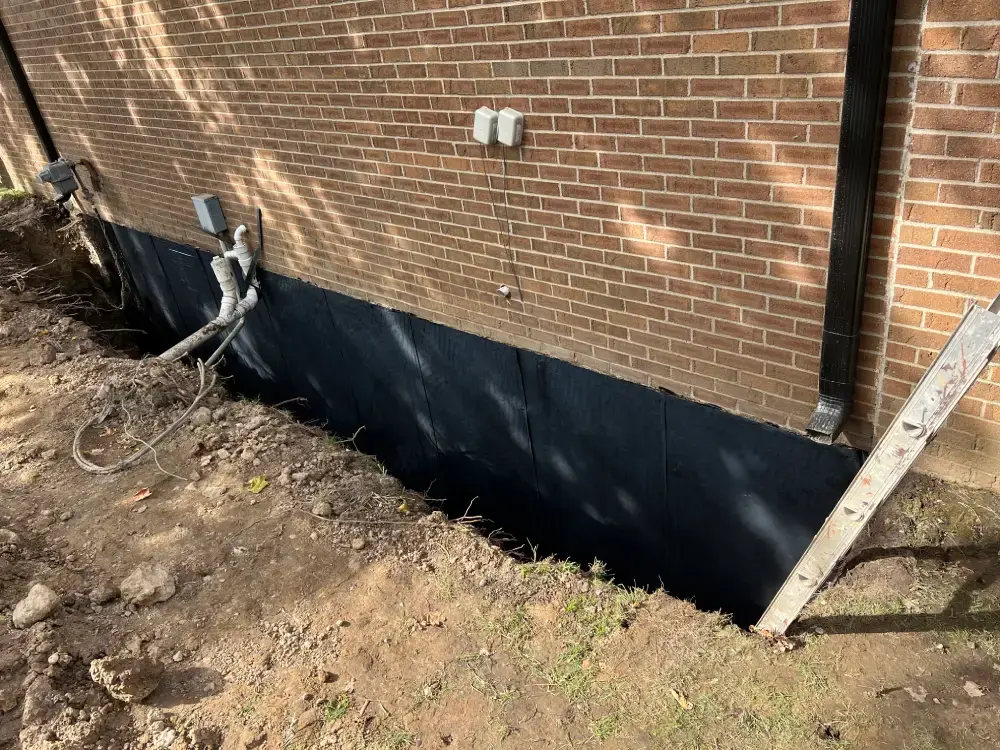
Want to stop basement leaks from the outside? Here’s how exterior waterproofing works, start to finish. Southeast Michigan clay holds water against your foundation. Over the years, the wall’s old coating breaks down, and water pushes through cracks and pores into the basement. First, we dig along the leaking wall, all the way down to the footing, so the whole outside of the wall is exposed. Next, we clean the wall and seal any cracks. Then comes a foundation coating that seals and bonds, a 60-mil rubber waterproofing membrane over it, and a dimpled foundation wrap on top, so water can’t sit against the wall. At the bottom, perforated drain tile with a filter sock goes in clean stone along the footing. The sock keeps out mud and sand, so only water gets in and the tile doesn’t plug up. It carries the water away to a sump or an outlet. Finally, we backfill with stone and soil, and slope the ground away from the house. Now water runs down the board, into the tile, and away from your basement.
Why Michigan Basements Leak Every Spring
Why do so many Macomb and Oakland County basements leak every spring? It comes down to clay soil and water pressure. Learn more about this service.
Read the video transcript
Why do so many Macomb and Oakland County basements leak every spring? It comes down to clay soil and water pressure. Much of Southeast Michigan sits on heavy clay. Clay drains slowly, so when the snow melts and the spring rains come, the ground around your house stays soaked. When a house is built, the hole for the basement gets backfilled with looser soil. That loose soil soaks up water like a sponge, and the clay around it holds it in, like a bowl. As that water rises, it pushes on the walls and up under the floor. That’s hydrostatic pressure, and it forces water through cracks, form tie holes, and the joint where the wall meets the floor. Watch for damp spots, white chalky lines on the walls, a musty smell, and water along the floor edges after a big rain. The fix depends on the house. Better grading and downspouts, crack injection, or a drain tile system with a sump pump.
What Waterproofing Costs in Southeast Michigan
What does basement waterproofing cost in Southeast Michigan? Here are our approximate price ranges, and what drives them. Learn more about this service.
Read the video transcript
What does basement waterproofing cost in Southeast Michigan? Here are our approximate price ranges, and what drives them. Interior drain tile runs approximately $60 to $120 per foot. Most whole jobs land between about $2,000 and $35,000. Exterior waterproofing runs approximately $150 to $300 per foot, because of the digging. Most jobs land between about $3,000 and $60,000. A full-height wall crack is approximately $1,000 to $2,500. Smaller cracks and tie rod holes run about $500 to $2,500. A standard sump pump system is approximately $2,500 to $3,000, and a battery or water-powered backup adds about $1,500. The biggest price drivers are how many feet of wall, how deep we dig, what’s in the way, like decks, driveways, or finished walls, and access for equipment. Every estimate is free, and the price is by the job, never by the hour.
Foundation Repair
How Epoxy Crack Injection Works
Got a leaking crack in your poured concrete basement wall? Here’s how crack injection seals it, all the way through. Learn more about this service.
Read the video transcript
Got a leaking crack in your poured concrete basement wall? Here’s how crack injection seals it, all the way through. Poured walls crack as the concrete cures and the house settles. When the soil outside gets wet, water finds that crack and runs right through the wall into your basement. First, we clean the crack and set injection ports along it. Then we seal the surface with an epoxy paste, so the injection can’t leak back out. Next, we inject epoxy from the bottom port up. It fills the crack through the full thickness of the wall, until it shows at the next port. We use epoxy because it does more than plug the leak. It bonds the concrete back together, and cures harder than the concrete around it. Once it cures, the ports come off, and the crack is sealed from the inside, without digging up your yard.
Bowing Walls and Steel I-Beam Braces
Is your basement wall bowing inward? Here’s how steel I-beam braces stop it. Learn more about this service.
Read the video transcript
Is your basement wall bowing inward? Here’s how steel I-beam braces stop it. Walls bow when wet clay outside swells and freezes, and pushes harder than the wall was built to take. You’ll often see a long horizontal crack, and the wall leaning in at the middle. First, we measure how far the wall has moved, and check the cracks, to make sure bracing is the right fix. Then steel I-beams are set against the wall, about every four to six feet. Each beam is anchored to the floor at the bottom, and to the floor joists at the top. The beams hold the wall in place and stop it from moving further. Some systems can be adjusted over time, to help push the wall back. A wall that’s badly bowed may need to be dug out and straightened first. And fixing the drainage outside keeps the pressure down.
Drainage, Window Wells and Sump Pumps
Downspouts, Grading and Dry Wells
Keeping water out of your basement starts outside. Here’s how downspouts, grading, and dry wells work together. Learn more about this service.
Read the video transcript
Keeping water out of your basement starts outside. Here’s how downspouts, grading, and dry wells work together. Your roof collects a lot of water. One inch of rain on an average roof is around a thousand gallons, and a short downspout dumps it right next to your foundation. If the ground slopes toward the house, that water runs straight to the wall. The ground should slope away, about 6 inches over the first 10 feet. Downspouts should carry the water well away from the house. A buried extension runs it underground, and lets it out at a pop-up emitter in the yard. Where there’s nowhere for it to drain, a dry well collects the water underground, and lets it soak into the soil slowly. Less water at the wall means less pressure on your foundation, and a drier basement. It’s often the first thing we look at.
Egress Window Wells That Don’t Flood
Adding an egress window to your basement? Here’s how to build the window well, so it doesn’t flood. Learn more about this service.
Read the video transcript
Adding an egress window to your basement? Here’s how to build the window well, so it doesn’t flood. An egress window gives a basement bedroom a safe way out in an emergency. It needs a window well outside, big enough to climb out of. A well with no drainage turns into a bucket. Rain and snowmelt pile up against the glass, until water leaks in around the window. So at the bottom of the well, we set a drain tied into the drain tile at the footing, with clean stone on top. The well liner is anchored to the foundation, with a ladder or steps if it’s deeper than 44 inches. And the ground around it slopes away. A clear cover keeps out snow, leaves, and most of the rain, still lets the light in, and opens from inside.
Sump Pump Backups: Battery vs. Water-Powered
If your sump pump stops during a storm, your basement can flood in hours. Here’s how backup pumps keep the water moving. Learn more about this service.
Read the video transcript
If your sump pump stops during a storm, your basement can flood in hours. Here’s how backup pumps keep the water moving. Main pumps fail for a few reasons. The power goes out in a storm, the float switch sticks, or the pump simply wears out. A battery backup pump sits in the pit next to the main pump. If the water rises past the main pump, it switches on, and runs off a deep-cycle battery. It works in any home, but the battery only lasts so long in a long outage, and it needs checking and replacing every few years. A water-powered backup runs on city water pressure. Water rushing through it creates suction that pulls the water out of the pit. No battery, and no electricity. It needs city water with good pressure, not a well, and it uses city water while it runs. It also needs a backflow preventer to protect your drinking water. Many homes do best with a solid main pump, a backup, and a high water alarm that warns you before it’s too late.
Flooded Basement: The First 24 Hours
Basement flooded? Here’s what we do in the first 24 hours, and why speed matters. Learn more about this service.
Read the video transcript
Basement flooded? Here’s what we do in the first 24 hours, and why speed matters. First, safety. Stay out of standing water near outlets or appliances. Then we find where the water came from: a sewer backup, groundwater, or a failed sump pump. Next, we pump out the standing water, and extract what’s soaked into the carpet. Soaked materials that can’t be saved, like carpet and pad, wet drywall, and framing, get torn out and hauled away, so mold doesn’t get a start. Then we disinfect, and air movers and dehumidifiers dry out the space. Mold can start growing in 24 to 48 hours, so drying fast matters. Last, we fix the cause, like a new sump pump, a backwater valve, or drain tile, so it doesn’t happen again. We handle the cleanup and drying, not the rebuild.
Sewer and Water Lines
How a Backwater Valve Works
Ever had sewage come up through a basement floor drain? Here’s how a backwater valve stops a city sewer backup. Learn more about this service.
Read the video transcript
Ever had sewage come up through a basement floor drain? Here’s how a backwater valve stops a city sewer backup. Your floor drain and plumbing empty into the sewer lateral, which runs out under your yard to the city’s main sewer line. During a heavy storm, the city main can fill up. With nowhere else to go, sewage pushes backward up the lateral, and out of the lowest opening in your house: the basement floor drain. A backwater valve goes into that line, inside the basement. We open the floor, cut the valve into the pipe, and finish it with an access cover, flush with the floor. Water still flows out normally. But when the main backs up, a flap inside the valve swings shut, and the sewage stops right there. Have the valve checked once or twice a year to keep the flap clean. A permit and inspection are usually required for this work.
Your Sewer Lateral, Explained
Your sewer lateral is the pipe that carries everything from your house to the city sewer. Here’s what you should know about it. Learn more about this service.
Read the video transcript
Your sewer lateral is the pipe that carries everything from your house to the city sewer. Here’s what you should know about it. It starts at your house, runs under the yard, and connects to the city main, usually under the street. In many Southeast Michigan cities, the homeowner is responsible for the whole lateral, from the house all the way to the main. Rules vary by city, so it pays to check yours. Warning signs include slow drains all over the house, gurgling toilets, water backing up at the floor drain, a sewer smell, or a soggy patch in the yard. Older clay and cast iron lines crack, sag, and pull apart at the joints. And tree roots grow right in, looking for water. A sewer camera inspection shows exactly what’s wrong, and where, so we only dig where we need to. Then the damaged section, or the whole line, is replaced with new pipe, with a permit and inspection.
Water Service Line Replacement, Step by Step
Is it time to replace your water service line? Here’s how it’s done, step by step. Learn more about this service.
Read the video transcript
Is it time to replace your water service line? Here’s how it’s done, step by step. Your water service line brings city water from the curb stop near the street, under the yard, to the meter in your basement. Older lines are often galvanized steel, which rusts from the inside, or lead, which needs to come out. Low water pressure, rusty water, or a wet spot in the yard are common signs. First, the old line is located and marked, and the water is shut off at the curb stop. Then a new copper or plastic line goes in, in an open trench, deep enough to stay below the frost line. It’s connected at the curb stop, and at a new shutoff valve by the meter. Then it’s pressure tested, and inspected before the trench is closed. Finally, the yard is backfilled, and you’ve got full water pressure again.
What a Sewer Camera Inspection Shows
What does a sewer camera inspection actually show you? Here’s how it works. Learn more about this service.
Read the video transcript
What does a sewer camera inspection actually show you? Here’s how it works. A waterproof camera on a long push cable goes into the line through a cleanout, a floor drain, or a toilet flange. As it travels out toward the city main, we watch the live picture. Roots, cracks, sags that hold water, broken joints, and grease buildup all show up clearly. A small transmitter in the camera head lets us find it from above ground. We mark the spot and the depth of any problem, right on your yard. You get the video and a written report, so you know exactly what’s wrong before anyone digs. Our camera inspection, with the locate, video, and report, runs about $350. It’s a smart move before you buy a house, too.
Hydro Jetting vs. Snaking a Drain
Snaking a drain, or hydro jetting it? Here’s the difference, and why it matters. Learn more about this service.
Read the video transcript
Snaking a drain, or hydro jetting it? Here’s the difference, and why it matters. Over time, sewer and drain lines build up grease, soap scum, sludge, and tree roots. The pipe gets narrower, until it backs up. A drain snake, or auger, drills a hole through the clog. Water flows again, but most of the buildup is still stuck to the pipe walls, so the clog often comes back. A hydro jetter sends water at thousands of PSI through a special nozzle. Forward jets cut through the blockage, and rear jets scrub the pipe walls and flush the debris away. The result is a pipe cleaned close to its full width. That’s why jetting is the go-to for grease, sludge, and roots. We usually run a camera first, to make sure the pipe is solid enough to jet, and again after, so you can see the result.