


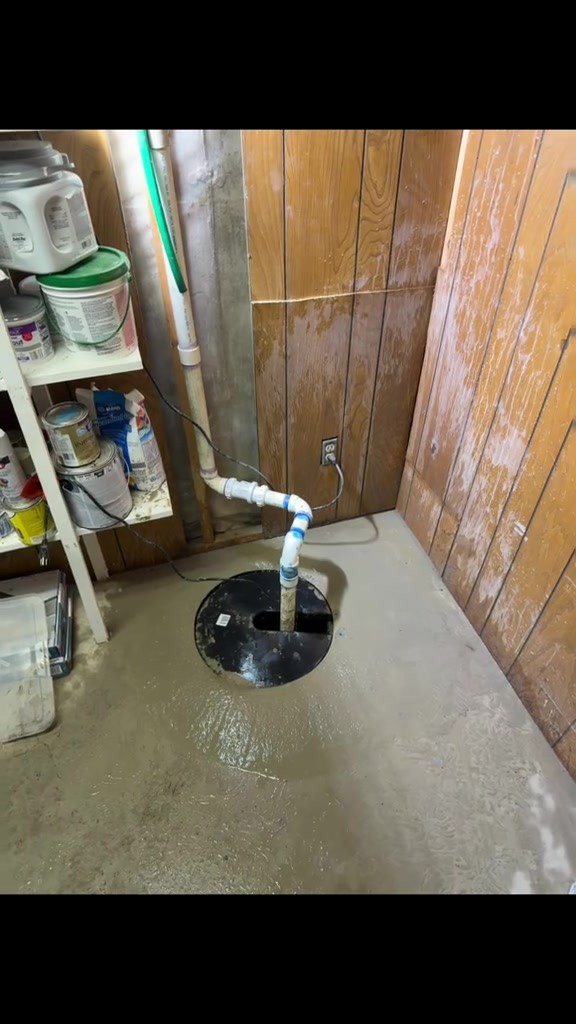
We install and replace a lot of sump pumps across Macomb and Oakland County, and most of the “my pump is broken” calls we get are not actually a broken pump. They are a stuck float, a failed check valve, a frozen discharge line, or a pump that was never big enough for the water it is being asked to move. Here is how to tell which one you have, in the order we check them.
The pump will not turn on
- Power. Check that it is plugged in (the plug for the pump and the plug for the float are sometimes piggybacked; both must be in). Check the breaker and the GFCI outlet. Storms trip GFCIs.
- Float switch stuck. Lift the float by hand. If the pump kicks on, the float is hanging up on the side of the pit, the discharge pipe or a cord. Tethered floats in small pits do this constantly. Reposition it or switch to a vertical float.
- Float switch dead. If lifting the float does nothing but plugging the pump directly into the outlet (bypassing the float plug) makes it run, the switch is bad. Switches fail before motors do.
- Motor dead. No hum, no run, with power confirmed: the pump is done. Most pumps last 7 to 10 years in our clay; a pump that runs every spring and fall day is on the short end of that. See when to replace a sump pump.
- Impeller jammed. It hums but does not pump: unplug it, pull it, and clear the gravel or debris from the intake.
The pump runs but no water leaves (or it comes right back)
- Check valve failed. The check valve on the discharge pipe keeps water in the pipe from falling back into the pit when the pump stops. When it fails, the same water goes up and comes back down over and over. You hear the pump run for a few seconds, stop, water gurgle back, repeat. A check valve is a $20 to $40 part and the most common cause of a pump “running constantly.”
- Discharge line frozen. Michigan problem, December through March. The line outside freezes, the pump runs against a closed pipe, and either burns out or the pit floods. Look for a frozen or ice-filled pipe at the exit point. Short-term: a temporary hose from the pit to a floor drain or outside, and thaw the line. Long-term: a freeze-relief fitting at the house that lets water escape if the line is blocked, a buried discharge line below frost depth (42 inches in Southeast Michigan) with a pop-up at the end, and a grade that drains. We bury a lot of discharge lines for exactly this reason.
- Discharge line crushed or clogged where the lawn crew drove over it, or the end is buried in mulch.
- Airlock. A pump that spins but will not move water can be airlocked. There should be a small weep hole drilled in the discharge pipe just above the pump, below the check valve, so air can escape. Many installs skip it.
The pump runs constantly
- Failed check valve (above). Fix that first.
- Float set too low or stuck “on.” Vertical float rods slip. The pump never gets to shut off.
- High water table. After a week of rain, or in spring, the ground is saturated and the pump really does have that much water to move. If it is cycling every minute or two for days, the pump is doing its job. If this happens in a pit with no drain tile feeding it, the water is coming from under the slab and your basement is one pump failure from flooding; that is where a proper drainage system and a backup pump come in.
- Pit too small or pump too big. A big pump in a small pit empties it in two seconds, shuts off, and the water refills immediately. Short cycling kills pumps. The fix is a bigger basin or a pump sized to the pit.
- A water source that should not be there. A broken water service line, a leaking sprinkler line or a neighbor’s discharge pointed at your house will run a pump in dry weather. If your pump runs in August with no rain, call us; we trace it.
This Troy home had an old-school setup with no basin at all, a capped pipe sitting in the mud. It ran constantly and still let water in. Here is what replacing it with a real sump system looks like:
The alarm is going off
A high-water alarm (on a battery backup system, a smart pump or a separate float alarm) means water is above the level the primary pump should have handled. Either the primary failed (go through the list above), the power is out and the backup is running, or the inflow is more than the pump can keep up with. Do not just silence it. Look in the pit. If the water is at the top and the primary is not running, you have minutes, not hours; a utility pump or a replacement pump is the move. If the backup is running on battery, remember a battery gives you hours, not days, so get the primary going or get power to it.
What you can fix yourself vs. when to call
Plugging the pump back in, freeing a stuck float, replacing a check valve, thawing a discharge line and swapping a like-for-like pump are all homeowner jobs if you are comfortable with them. Call us when the pump is sized wrong for the water, the pit has no drain tile and the floor is wet around it, the discharge line needs to be buried, the basement floods when the power goes out, or you simply want a pro to do it. A pump swap is approximately $600. A complete new sump system (basin, pump, check valve, sealed lid, discharge) is approximately $2,500 to $3,000, and a battery backup adds roughly $1,500. More on our sump pump page and in the sump pump cost guide.
Frequently asked questions
Why does my sump pump keep running when there is no rain?
Most often a failed check valve recycling the same water, a stuck float, or a high water table that lags rain by days. If it continues in dry weather, suspect a leaking water line or a neighbor’s discharge.
How long should a sump pump run per cycle?
Roughly 10 to 30 seconds and then rest. A pump that runs for only a second or two is short cycling (pit too small); one that runs for minutes is fighting a clogged line, a bad check valve or too much water.
What does it mean when the sump pump alarm goes off?
Water is higher than the primary pump should allow. Check the pit immediately: the primary pump has failed, the power is out, or the inflow is more than it can handle.
Can a sump pump discharge line freeze?
Yes, every winter in Michigan. A freeze-relief fitting and a buried line below the 42-inch frost depth prevent it.
How often should a sump pump be tested?
Pour a bucket of water in the pit every couple of months and before spring thaw. If it does not start and stop cleanly, fix it before the rain does the test for you.
Mansour’s Innovations is a family-owned waterproofing, excavation and plumbing contractor in Shelby Township, Michigan, serving Macomb, Oakland and Wayne counties since 2014. Owner Imad “Matt” Mansour has 20+ years in the trade and the crew has completed 1,600+ projects. Our waterproofing work carries a 25-year transferable limited warranty. Call or text (586) 345-7292 for a free estimate.