


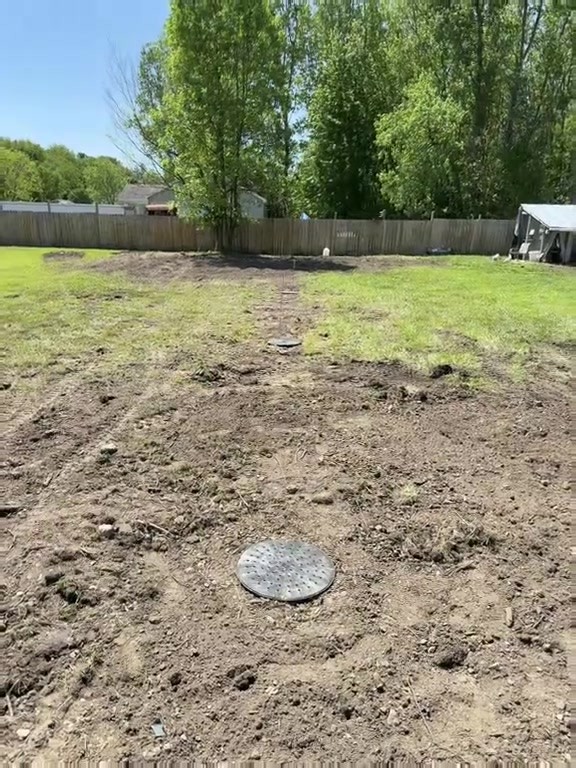
Most of Macomb and Oakland County sits on clay. Clay holds water the way a bowl does, which is great for ponds and terrible for lawns. If your yard has a spot that stays soft for three days after a storm, water pools against the house, or the dog comes in muddy from the same corner every time, this is for you. Matt has been fixing drainage in these yards for 20+ years, and these are the fixes that work, matched to the problem.
Watch: Downspouts, Grading and Dry Wells
Read the video transcript
Keeping water out of your basement starts outside. Here’s how downspouts, grading, and dry wells work together. Your roof collects a lot of water. One inch of rain on an average roof is around a thousand gallons, and a short downspout dumps it right next to your foundation. If the ground slopes toward the house, that water runs straight to the wall. The ground should slope away, about 6 inches over the first 10 feet. Downspouts should carry the water well away from the house. A buried extension runs it underground, and lets it out at a pop-up emitter in the yard. Where there’s nowhere for it to drain, a dry well collects the water underground, and lets it soak into the soil slowly. Less water at the wall means less pressure on your foundation, and a drier basement. It’s often the first thing we look at.
Why your yard holds water
Sandy soil drains at inches per hour. The clay under a Sterling Heights or Shelby Township subdivision drains at a fraction of an inch per day. Rain has nowhere to go but sideways or up, so it finds the low spot and sits. Add a builder’s grade that settled toward the house, downspouts that drop 2,000 gallons of roof water into a flower bed, a fence or patio that blocks the old flow path, and a neighbor whose yard is six inches higher than yours, and you get a yard that floods and a basement that leaks.
Match the fix to the problem
Problem: water pools next to the foundation
This one matters most, because it is the water that ends up in your basement. Fixes, in order:
- Downspouts. Extend them at least 6 to 10 feet from the house, or better, bury the downspout line and run it to a pop-up emitter in the lawn or to a storm drain. Here is an underground downspout system in Washington Township replacing one that had failed:
- Regrade. The ground should drop about 6 inches in the first 10 feet away from the house. Years of settling and mulch build-up reverse that. We bring in clay fill (not topsoil, which lets water straight through to the foundation), regrade and reseed or sod.
- Catch basin by the house. Where regrading is not possible (a patio, a walkway, a neighbor’s yard sloping at you), a catch basin collects the water and a pipe carries it away. This Bloomfield Hills home had water pooling against the foundation; a catch basin tied to a dry well fixed it in a day:
Problem: a soggy low spot in the middle of the yard
- French drain. A trench with perforated pipe in washed stone, wrapped in fabric, running from the wet area to somewhere lower. It collects the water that is sitting in the soil and gives it a path. Works well in clay because the pipe and stone do the draining the soil cannot. See our French drain installation guide.
- Regrading to remove the bowl, if there is somewhere to send the water.
- A catch basin in the low spot with a pipe to daylight, a ditch or a storm sewer (with the city’s permission).
This Shelby Township yard held water in the back every spring; grading plus a French drain solved it.
Problem: water comes from a neighbor or the whole yard is wet
For large areas, a network of French drains and catch basins collected to one outlet. If there is a creek, ditch or storm sewer downhill, we run to it by gravity. If there is not, the water has to be pumped: a drainage basin with a pump, discharged somewhere it can go. This Imlay City property had severe drainage issues across the whole back yard; two days of trenching and a system pumped to the creek.
Problem: garage or walkout floods under the door
A channel (trench) drain across the opening, tied to a drain line. We did exactly that for a Davisburg garage that turned into a pool every storm.
A straight answer about dry wells in clay
A dry well is a buried chamber that holds water and lets it soak into the ground. In sandy soil it is a great outlet. In heavy clay it fills up and stays full, because the soil around it cannot absorb the water fast enough. We install them where a test hole shows the soil drains (parts of northern Macomb and Oakland have sandier pockets), and we size them for the roof or sump water they will see. Where the clay is solid, we tell you up front that a dry well will not work and the water needs a real outlet or a pump. This Sterling Heights home had the right soil for one, handling the sump pump discharge:
What does not work
- Topsoil and seed dumped in the low spot. It settles and the puddle comes back.
- A French drain with nowhere to drain to. Pipe in stone that ends in clay is just a longer puddle.
- Aeration and “soil conditioners” for a drainage problem. They help a lawn breathe; they do not move water.
- Pointing your downspouts or sump discharge at the neighbor. It is also illegal in most of our cities.
Permits and the county
Any drainage work that discharges to a county drain, a ditch or a storm sewer needs permission, and soil erosion permits apply when we disturb enough ground near water. We handle Macomb County and local permits as part of the job.
What it costs
Every yard is different enough that we quote after walking it. As a rough guide, approximately: burying downspouts is the least expensive item; a French drain or catch basin run is priced by the foot and the outlet; a full-yard system with a pump is a multi-day excavation job. Estimates are free, and we will tell you if the cheap fix is enough. See our yard drainage and French drain page.
Frequently asked questions
Why does my yard hold water after it rains?
Clay soil drains very slowly, so rain pools in low spots and against the house instead of soaking in. Settled grading and downspouts dumping near the foundation make it worse.
How do I get rid of standing water in my yard?
Give it a path: extend or bury downspouts, regrade away from the house, and install a French drain or catch basin to a real outlet (storm sewer, ditch, daylight) or a pump.
Does a French drain work in clay soil?
Yes, if it has an outlet. The pipe and stone move the water the clay cannot, but the trench has to end somewhere lower.
Will a dry well work in clay?
Usually not. It fills and stays full. We test the soil first and recommend a pumped or piped outlet where the clay is solid.
Is standing water in the yard bad for the foundation?
Yes. Water sitting against the house raises the water table around the foundation and ends up in the basement. It is the first thing we fix on any wet-basement job.
Mansour’s Innovations is a family-owned waterproofing, excavation and plumbing contractor in Shelby Township, Michigan, serving Macomb, Oakland and Wayne counties since 2014. Owner Imad “Matt” Mansour has 20+ years in the trade and the crew has completed 1,600+ projects. Our waterproofing work carries a 25-year transferable limited warranty. Call or text (586) 345-7292 for a free estimate.