


Steel I-beam braces and carbon fiber for basement walls that bow, lean or crack sideways. Free estimates across Southeast Michigan.
Most basement problems are about water. A few are about the wall itself. When wet clay and frost push on a basement wall, it can crack sideways, bow in at the middle or lean in at the top. Sealing the crack won’t stop that. The wall has to be reinforced.
We reinforce moving walls in two ways: steel I-beam wall braces and carbon fiber strips. We fill the cracks that come with them, and we look for the water that caused the push. Mansour’s Innovations is based in Shelby Township, and we take foundation repair jobs anywhere in Southeast Michigan. The estimate is free. Call (586) 345-7292.
Signs your basement wall is moving, not just leaking
- A horizontal crack. A crack running sideways along the wall, often partway up a block wall, usually means wet or frozen clay is pushing the wall in. This is the sign to take most seriously.
- A wall that bows or leans. Hold a long level against the wall, or stretch a string from one corner to the other. If the middle bulges in, or the top leans in compared with the bottom, the wall is moving.
- Stair-step cracks that keep growing. Cracks that zigzag along the mortar joints of a block wall can come from settling or from pressure. If the blocks above the crack no longer line up with the blocks below, the wall has moved.
- A crack that’s getting wider or has shifted. A crack that’s wider than it was last year, wider at one end, or offset so one side sticks out past the other is still moving.
- The top of the wall sliding in. A gap opening where the wood framing sits on the foundation points to the same pressure as a bowing wall.
What usually isn’t structural: a thin vertical crack in a poured wall that stays the same width. Concrete shrinks as it cures, and most poured walls have a crack or two. If one leaks, it needs crack injection, not bracing.
To keep track of a crack, mark both ends with a pencil, write the date next to it and measure the widest point. Check it again after the next wet season. Our guides to vertical vs. horizontal basement cracks, bowing basement walls and the 7 signs a foundation wall is moving go into more detail.
Why basement walls bow in Southeast Michigan
A basement wall holds back the soil around your house, and around here that soil is mostly clay. Three things make it push harder:
- Wet clay. Clay holds water against the wall for days after a rain, and that water adds its own pressure.
- Frost. Water in the top few feet of soil freezes, expands and pushes sideways on the wall.
- Roof and yard water. Downspouts that empty next to the house, and yards that slope toward it, soak the soil right where the wall is.
Block walls bow more often than poured walls, because the mortar joints are the weak spot: the wall bends at a joint and leans in above it. Many older houses here sit on concrete block, from the postwar neighborhoods of Warren, Roseville and Eastpointe to the boom-era houses of Sterling Heights, the south ends of Clinton and Shelby townships, and Waterford’s lakefront ranches. Poured walls usually crack straight up and down and leak, but they can crack sideways too when wet clay freezes against them.
Crack injection or wall bracing?
The direction of the crack and whether the wall has moved decide the repair. Here’s how it usually sorts out.
| What you see | What it usually needs |
|---|---|
| A vertical crack or tie-rod hole that leaks | Crack injection from inside |
| A wall that has only started to bow | Carbon fiber reinforcement |
| A wall that is bowing or leaning more | Steel I-beam wall braces |
| A long horizontal crack in a block wall | The whole crack filled, plus braces |
| Water along the floor-wall joint | Drainage (interior drain tile and a sump), not injection |
When crack injection is enough
If the wall is straight and the crack runs up and down, injection is usually the whole job. We fill the crack through the full thickness of the wall with polyurethane or epoxy, from inside, with no digging. That covers most leaking cracks in poured walls and the tie-rod holes left from the forms. See foundation crack injection.
When the wall needs bracing
If the crack runs sideways, or the wall bows, leans or has shifted, the wall is being pushed. Injection alone would stop the water for a while, but the wall keeps moving and the crack opens again. The wall needs carbon fiber or steel braces, and the crack gets filled as part of the same job.
How steel I-beam wall braces work
Steel I-beam braces are for walls that are bowing or leaning more than a little. Each brace is a steel I-beam set upright against the inside of the wall. The top is fastened to the floor joists above, and the bottom is anchored at the footing below the basement floor. Spaced along the wall, the beams hold it where it is, so it doesn’t keep coming in and the crack can be repaired.
- A long horizontal crack in a block wall, sometimes 20 feet or more, usually needs the whole crack filled plus braces.
- The beams stand a few inches out from the wall, so plan around them if you finish the basement later.
How carbon fiber wall reinforcement works
Carbon fiber is for a wall that has only started to move. Strips of carbon fiber are bonded to the inside face of the wall with epoxy, running from the bottom of the wall to the top and spaced along its length. Once they’re bonded, they keep the wall from moving further. They don’t push it back.
- The strips are thin and lie almost flat against the wall.
- The work is done from inside the basement, with no digging.
What we don’t do
We don’t do piering, underpinning or slab jacking. Those fix a house or a slab that is sinking, which is a different problem from a wall being pushed in. If that’s what we find, we’ll tell you so you can call the right contractor.
Fix the water that caused the push
Braces and carbon fiber hold the wall. They don’t keep the clay behind it dry. If roof water and the yard keep soaking the soil against that wall, the repair is holding back a wall that keeps getting pushed. So at every estimate we look at the gutters, downspouts and grading along with the wall.
- Downspouts and grading. Yard regrading, French drains and dry wells: see exterior drainage.
- Water at the floor-wall joint. Interior waterproofing with drain tile and a sump.
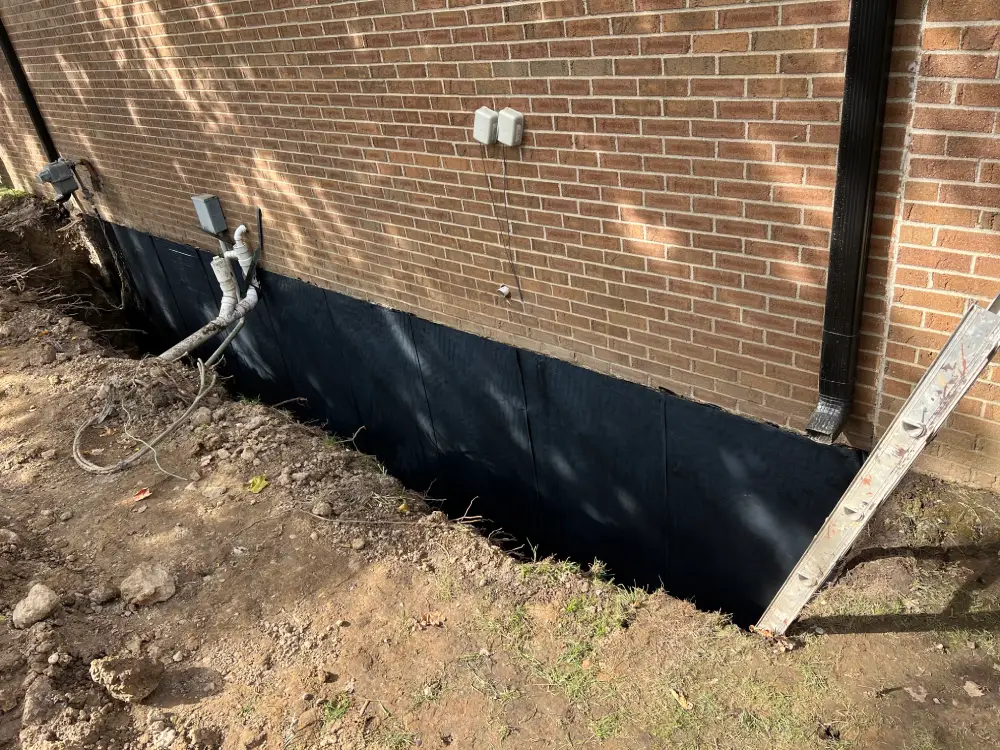
- A wall that leaks in many places. Exterior waterproofing: we dig to the footing, apply a membrane and lay new drain tile.
Our foundation repair process
- Free estimate. We look at the wall, measure how far it has moved, check which way the cracks run, and walk around the outside to see where the water comes from.
- One written price. You get one written price before we start. Financing is available through Enhancify.
- Permit. We can pull the building permit for you.
- Getting the wall ready. Anything stored along the wall gets moved. On a finished basement, the drywall has to come off where the braces or strips go.
- The repair. We fill the crack and install the braces or the carbon fiber.
- Inspection and cleanup. Your city inspects the work if your permit calls for it. We clean up and show you the finished repair.
Permits for wall bracing and reinforcement
Bracing or reinforcing a basement wall, with steel or carbon fiber, is structural work, and under Michigan’s residential code it generally needs a building permit. Your city or township building department decides, and each one sets its own fees and inspections. We can pull the permit for you.
How long it takes
We don’t promise a timeline before we’ve seen the wall. How long your job takes depends on:
- how many braces or strips the wall needs, and how many walls are involved
- whether finished walls have to be opened up first
- your city’s permit and inspection schedule
- whether drainage or waterproofing work is part of the same job, and the weather for anything outside
Ask us at the estimate, and we’ll tell you what to expect for your wall.
What foundation repair costs
Every repair is priced after we see the wall. The estimate is free, and the price is put in writing before any work starts.
What moves the price:
- the length of the wall, and how many braces or strips it needs
- how far the wall has moved
- how many cracks there are, and how long they are
- finished walls that have to be opened up
- water coming in along the floor too, which needs drainage
The estimate for a repair is free. If you only want a wall or a crack checked, with no repair in mind, that’s a paid diagnostic visit; ask about the fee when you call. There is more on costs in our basement waterproofing cost guide. Financing for residential and commercial jobs is available through Enhancify.
What the warranty covers, and what it doesn’t
Our 25-year transferable limited warranty covers waterproofing work only: interior, exterior and new foundation waterproofing, and crack injection. It covers our workmanship only.
- Wall reinforcement isn’t covered by it. Steel I-beam braces and carbon fiber carry only the warranty written on your contract or invoice, plus any manufacturer’s warranty.
- Cracks we inject are covered along the length we injected. Leaks from new cracks, or from wall movement that needs structural repair, aren’t.
- French drains, dry wells, the sump pit and the pump aren’t covered either. See what the warranty doesn’t cover.
Every job also comes with our Workmanship Promise: if something about our workmanship isn’t right when we finish, tell us within 7 days and we’ll come back and correct it.
Foundation repair across Southeast Michigan
We’re based in Shelby Township and take foundation repair jobs anywhere in Southeast Michigan, including Macomb County, Oakland County and Wayne County. That includes Sterling Heights, Macomb Township, Rochester Hills, Waterford Township, Shelby Township, Clinton Township, Troy and the other communities we serve.
Mansour’s Innovations LLC is a family-owned company founded in 2014, with 1,600+ projects completed. Owner Matt Mansour has more than 20 years in the trade. We’re fully licensed, bonded and insured, with 4.9 stars from 110+ Google reviews.
Water pouring through a crack, or a wall that has moved suddenly? Call (586) 345-7292. We’re available 24/7 for emergencies and typically reply within 2 hours.
Frequently Asked Questions
Get a free foundation repair estimate. Call (586) 345-7292 or request a quote online.