
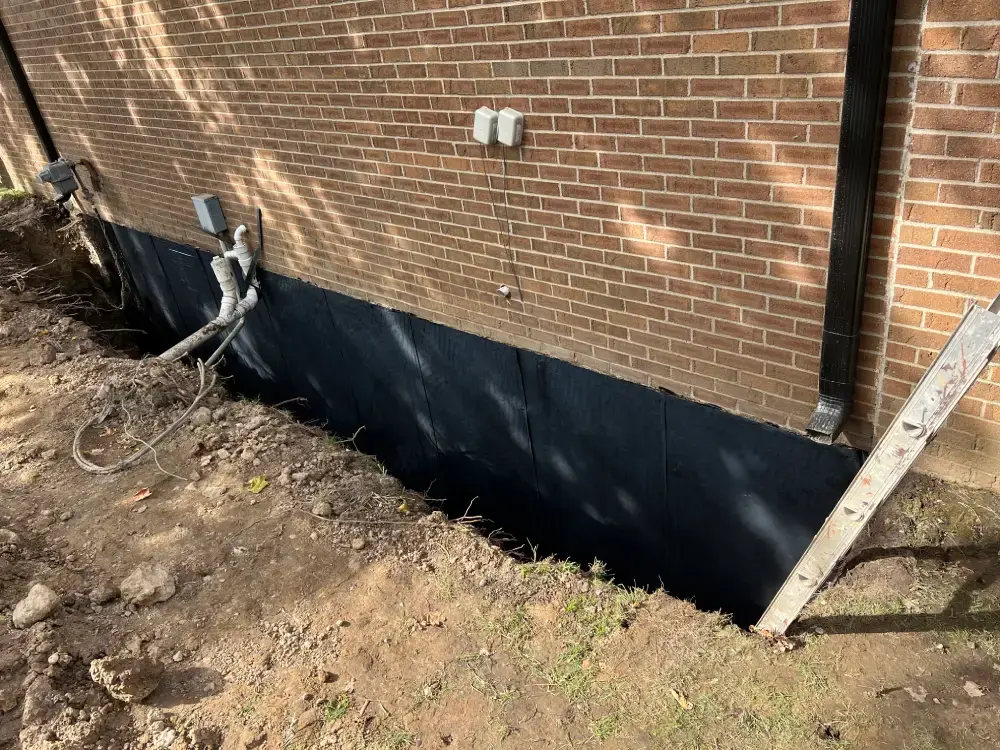
A French drain is simple in principle, which is why so many are built badly. The ones that work for decades and the ones that clog in a year look the same from the lawn. Here’s how we build one, step by step, and where the shortcuts usually happen.
1. Find the source and the outlet
We walk the yard, ideally during or after a rain, to see where water comes from and where it sits. Then we figure out where it can go: a lower part of the yard where it can daylight, a dry well, or a storm connection where the city allows it. A drain without a working outlet just stores water underground.
2. Call MISS DIG
Utility lines get marked before anybody digs. Private lines, like sprinklers or a line to a garage, don’t get marked, so we ask.
3. Dig the trench with a steady fall
The trench runs toward the outlet with a continuous slope. Flat spots and low bellies collect silt and stop working. We use our own compact excavator where it fits and dig by hand where it doesn’t.
4. Line it with filter fabric
This is the step cheap jobs skip. Southeast Michigan clay will migrate into bare stone and turn it into mud within a few seasons. Fabric lining the trench keeps the clay out.
5. Stone, pipe, stone
A bed of washed stone, then perforated pipe, then more stone over it. The fabric folds over the top so the whole column is wrapped.
6. Catch basins where surface water collects
If the problem includes water sitting on the surface, small catch basins or a stone cap let it get into the drain. A buried drain alone handles water moving through the soil.
7. Backfill and restore
Topsoil goes back, then seed or sod, and we run water through to make sure it reaches the outlet.
DIY pitfalls
- No fabric.
- Pipe laid flat or uphill in spots.
- An outlet that’s buried, blocked or freezes.
- Running it next to the foundation and soaking the backfill.
More on our French drain installation, or read about interior vs. exterior French drains.
We’re Mansour’s Innovations, a waterproofing, excavation and plumbing contractor in Shelby Township, in business since 2014 and working across Macomb, Oakland and Wayne counties. Call (586) 345-7292 for a free estimate. We book from 8 a.m. to 8 p.m. every day and answer emergency calls 24/7.