
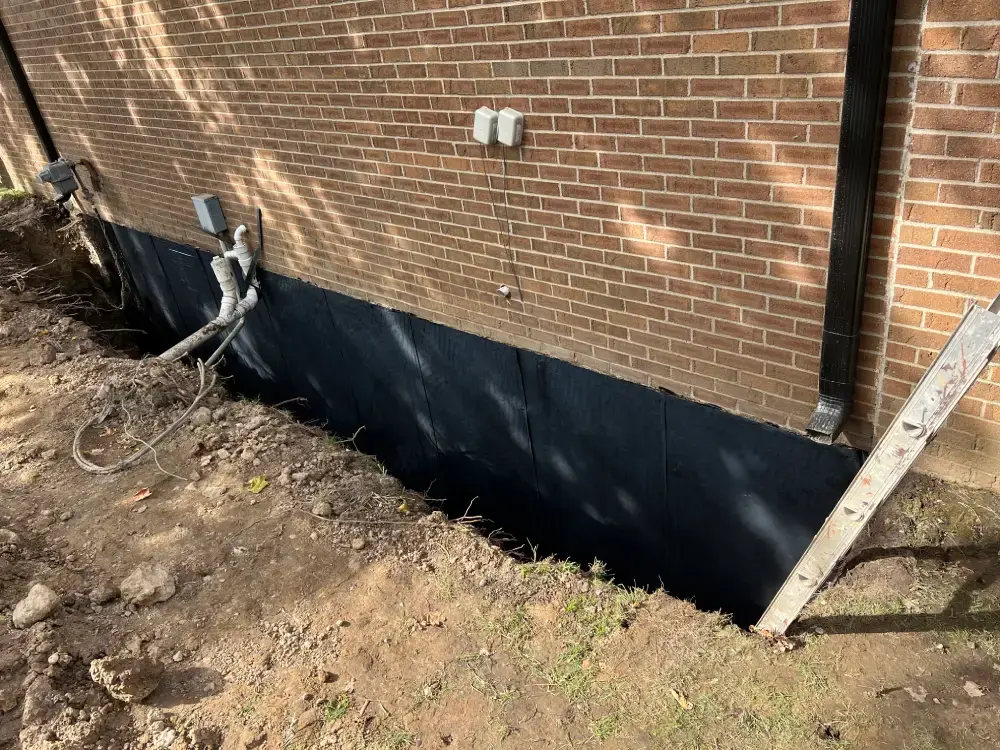
Some dampness after a hard rain is normal in a Southeast Michigan basement. Water running across the floor is not. Most of the calls we get land somewhere between those two, and a fair number of them don’t need us at all.
That’s the honest version. The rest of this is how to figure out which side of the line you’re on before you pay anybody to tell you.
Why clay keeps every basement around here a little wet
If you live in Macomb County, east Oakland or most of Wayne, your house sits on an old lake bed. The ground is dense gray and brown clay that settled out when the glacial lakes covered all of this. Clay doesn’t drain so much as it hoards. It drinks up a storm, swells, and then keeps that water pressed against your wall for the better part of a week after the sky clears.
So the outside of your wall is wet for a good part of the year. Concrete and block aren’t waterproof, they’re just slow. Some of that moisture wicks through, and on a sticky August afternoon the air in the basement adds its own. That’s why so many houses here have a basement that smells a little musty in summer and is perfectly fine by October.
Up in the hills of north and west Oakland the ground is sandier. Different problem.
Humid, damp, seeping and leaking are four different calls
People use these words interchangeably on the phone. We don’t.
Humid
The air is wet and the wall is dry. You’ll see sweat on the cold water pipes and maybe along the bottom of the wall in July. Tape a square of kitchen plastic wrap to the wall, run the tape all the way around so it’s sealed, and forget about it for two days. Beads on the room side of the plastic mean condensation. The cure is a dehumidifier parked near 50 percent with a hose to the floor drain or the sump, because nobody keeps emptying a bucket past the second week.
Wet on the wall side, under the plastic, and the water is coming through the concrete itself. Keep going.
Damp
Dark patches on the wall after rain that dry out in a day or two, and no standing water. This is very common on the concrete block walls under 1950s and 60s ranches, where water gets into the hollow cores and wicks out through the mortar joints. It’s annoying and often livable, and most of the time the fix is outside the house.
Seeping
A wet line where the floor meets the wall (we call that the cove joint), or a crack that darkens every time it rains. Water is getting in, slowly. This is where pressure from saturated soil starts to be the real explanation, and where we’d want to take a look.
Leaking
Water you can mop. A trickle from a crack or a tie-rod hole in a poured wall, puddles that come back every storm, water rising through the floor. Somebody needs to come out.
What to check before you call anyone
Do this in the rain if you can stand it. Ten minutes outside with an umbrella during a real downpour will teach you more than any inspection on a sunny Tuesday.
- Downspouts. Each one should let go at least six feet from the foundation, and farther is better. A downspout dumping at a corner puts a whole section of roof’s worth of water against that wall. An extension that got knocked off by the lawn crew in June is the most common cause of a “new” leak we walk into.
- Gutters. If they overflow at the front because they’re packed with maple seeds, the downspouts don’t matter.
- Grading. The dirt should fall away from the house. On a lot of 1960s ranches the backfill has settled over the decades and the ground now tips toward the wall. A sunken patio or driveway slab does the same thing.
- Window wells. Look down into them. Standing water, a mat of leaves over the drain, or a well that has pulled away from the wall and lets water run behind it will put water on the floor right under that window.
- The sump. Dump a five-gallon bucket into the pit, then stand there and watch the float rise and the pump clear it. The part people skip is listening after it shuts off. A rush of water falling back into the pit means the check valve has given up, and your pump has been lifting the same few gallons over and over. Then go outside and find where the line ends. If it empties next to the foundation, that water is coming straight back in.
Downspouts and grading cause more wet basements than anything we sell. If that’s your problem, you need extensions and a few yards of topsoil. Not a waterproofing contractor.
Where the water line shows up on the wall
We spend a while just looking at the wall before anybody opens a toolbox.
That white, chalky crust on the concrete has a name, efflorescence, and it tells a story. Water dissolves mineral salts out of the block or concrete on its way through, then evaporates and leaves the salt behind. It isn’t mold, but it’s proof water has moved through that wall more than once. A light dusting across a block wall is pretty normal here. When it piles up thick along one crack or one course of mortar, it’s drawing you a map to the leak.
Where the water shows up tells us more than how much of it there is.
High on the wall, up near the sill plate or around a window, the water is nearly always surface water. Think grading, a window well, a downspout, or a gap at the sill. That’s the good news, because it’s usually cheap. Water that only shows at the bottom, along the cove joint or up through cracks in the floor, is coming from below, from soil that’s soaked deep down at the footing. No downspout extension fixes that.
A horizontal crack in a block wall, especially if the wall is bowing in, is a separate and structural conversation. Call about that one even if it’s bone dry.
When it really is the drain tile
Most houses around here were built with drain tile around the footing. On homes from before about 1950 that’s usually short sections of clay tile, and after seventy-plus years it’s often silted full or crushed. On plenty of 1950s and 60s houses the footing drains were tied into the sewer, which works until the sewer backs up in a big storm. When the tile stops carrying water away, the water sits against the footing and builds pressure until it finds the weakest spot. That’s almost always the cove joint.
These are the signs that point there. You’ve already fixed the downspouts and the grading and it still gets wet. Water comes in along the bottom of more than one wall. It shows up the day after the rain, not during it. Or there’s no sump at all and the floor just gets wet every spring.
Then the fix is a new drain system. From the inside, we cut the floor along the walls, lay new tile at the footing and run it to a sump. From the outside, we dig the wall down to the footing, clean it, put on a membrane and new tile, and backfill with stone. We do interior drain tile on most basements because it handles the water right at the footing without tearing up the yard, and we dig the outside when the wall itself needs work.
One opinion we’ll stand behind. If only one wall gets wet and it’s the wall under a downspout, fix the downspout and wait out one spring before you spend real money. If a single crack in a poured wall is the only leak, that’s a crack injection, not a whole system.
March and April tell you the truth
Spring is when the clay is fullest and the frost is coming out of the ground. A basement that stays dry through a Michigan spring is in good shape. If yours doesn’t, take dated photos, write down where the water showed up and how many hours after the rain, and keep it. That record beats anything you can describe from memory.
One more reason to deal with seepage instead of living with it. Michigan’s insurance regulator says water coming up from the ground, like snowmelt through the foundation, usually isn’t covered by a homeowners policy. The free estimate is a phone call away at (586) 345-7292.