
Short answer: a musty smell in the basement is moisture. Mold and mildew need damp air or a damp surface to grow, and the smell is the gas they give off while they do it. Candles, sprays and “odor eliminators” cover it for a day. If you want it gone, you have to find where the water is getting in or where the humidity is coming from. In Matt’s 20+ years in basements across Macomb and Oakland counties, these are the causes we find most often, in order.
The 6 usual causes of a musty basement in Southeast Michigan
- High humidity, not a leak. Michigan basements sit in clay soil that stays cool and damp all year. When warm summer air comes down the stairs and hits a 58-degree wall or floor, it condenses. Relative humidity above about 60 percent is enough for mildew to grow on cardboard boxes, carpet backing and the paper face of drywall. This is the most common cause in a basement that never actually “leaks.”
- Seepage at the cove joint. The cove joint is the seam where the basement floor meets the wall. In a wet spring the water table rises, and water pushes up through that seam and evaporates before you ever see a puddle. The giveaway is a damp line or dark staining along the base of the wall, or a smell that is strongest after heavy rain.
- Carpet or laminate over a slab. Concrete floors wick ground moisture. Put carpet pad or a laminate underlayment on top and you trap it. Pull up a corner in a smelly basement and the back of the pad is usually dark and damp.
- A dried-out floor drain trap. If the smell is more “sewer” than “old books,” a basement floor drain trap that has dried out is letting sewer gas up into the room. Pour a bucket of water down it. If the smell changes, that was it.
- Leaking windows, window wells and rod holes. Water that comes in during rain, soaks into the block or the drywall, and dries out again leaves a mildew smell behind even though the floor looks dry the next day. Rod holes in poured walls and old glass block windows are the two spots we check first.
- Old flooding that was never dried out properly. If the basement took on water once (a sump failure, a 2021-style storm, a water heater) and the drywall, framing and carpet were not removed or professionally dried, the mold is still in there behind the finished wall.
Which one is yours? A 10-minute check
- Tape a 12-inch square of plastic or foil to the floor and another to the wall, seal all four edges, and leave it for 24 to 48 hours. Water under the plastic means moisture is coming through the concrete. Water on top means it is condensation from humid room air.
- Buy a cheap hygrometer. If the basement reads above 60 percent in summer, humidity is at least part of the problem.
- Look along the base of every wall for a tide line, white powder (efflorescence) or peeling paint. Those are water paths.
- Smell the floor drain and the sump pit separately. Each one tells you something different.
- Check behind anything stored against an outside wall. Mildew grows in the dead air behind boxes and furniture first.
What a dehumidifier can and cannot fix
A good dehumidifier set to 45 to 50 percent will clear a condensation problem and keep a dry basement smelling dry. It is the right first step if the plastic-sheet test shows moisture on top of the plastic and the walls look clean. What it cannot do is keep up with water coming through the floor or walls. We see plenty of basements in Sterling Heights, Warren and Clinton Township with two dehumidifiers running around the clock, buckets emptied twice a day, and the smell still there in May. That is not a humidity problem. That is a drainage problem, and the dehumidifier is just pumping out the groundwater one gallon at a time.
Fixing the cause
- Condensation only: dehumidifier, insulate cold water pipes, keep basement windows closed in summer (open windows let humid air in), and get boxes off the floor and off the outside walls.
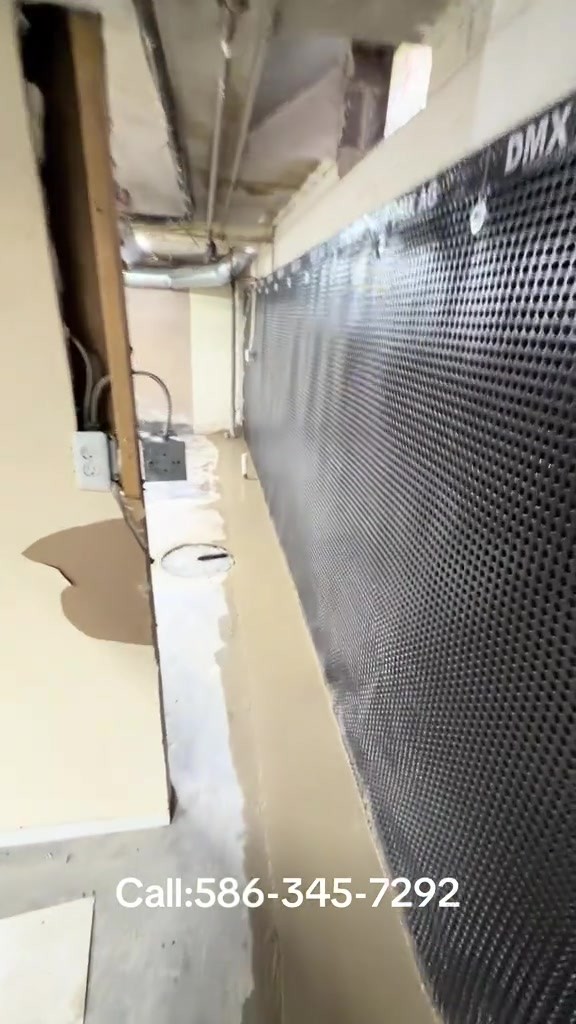
- Seepage at the cove joint or through the floor: an interior drainage system. We open the floor around the perimeter, set perforated drain tile at the footing, cover the lower wall with a dimpled membrane, and run everything to a sump pump. The water that used to sit under the slab and evaporate into the room now leaves through a pipe. This is the fix for most musty basements that get worse after rain.
- Water through the walls from outside: exterior waterproofing – excavate, clean the wall, apply membrane, replace the footing drain and backfill. It costs more but it keeps the wall itself dry, which matters if the basement is finished.
- Cracks, rod holes and windows: crack injection for poured walls, and rebuilding or resealing a leaking window sill. These are small jobs, often done in a day.
- Old flood damage: wet drywall and carpet have to come out. Mold inside a wall cavity does not dry out on its own. Our flood restoration crew handles tear-out and drying, then we fix whatever let the water in so it does not happen again.
Here is what an interior system looks like when it is finished. This Sterling Heights basement smelled musty every spring from hydrostatic pressure pushing water up through the floor; after the drain tile and sump went in, the smell went with the water.
What it costs
Approximately: a quality dehumidifier runs $200 to $350. Crack injection is approximately $500 to $600 for a small crack and $1,500 for a full-height crack. An interior waterproofing system is approximately $6,000 to $8,000 for a 40-foot wall, depending on how many feet of perimeter we open up (most homes land somewhere in the middle). Our full numbers are in the basement waterproofing cost guide. The waterproofing work we do carries our 25-year transferable limited warranty.
Frequently asked questions
Is a musty basement smell dangerous?
Mildew on its own is mostly a nuisance, but the same moisture that feeds it feeds mold, and people with asthma or allergies feel it upstairs. Basement air moves up through the house (the stack effect), so a musty basement means you are breathing it in the living room too.
Will a dehumidifier get rid of the musty smell?
If the problem is condensation, yes, usually within a week or two at 45 to 50 percent humidity. If water is coming through the floor or walls, a dehumidifier only treats the symptom and will run nonstop.
Why does my basement smell musty after it rains?
Rain raises the water table in Michigan clay, and water is pushing up through the cove joint or the floor and evaporating. That is seepage, and an interior drainage system is the usual fix.
Can I just paint the walls with waterproofing paint?
Paint can slow dampness through block, but it does not stop water with pressure behind it and it does nothing for the cove joint. We cover this in our article on whether Drylok actually works.
Do you inspect basements for the source of a smell?
Yes. We do moisture-meter and thermal imaging inspections across Macomb, Oakland and Wayne counties, and estimates for the repair are free.
Mansour’s Innovations is a family-owned waterproofing, excavation and plumbing contractor in Shelby Township, Michigan, serving Macomb, Oakland and Wayne counties since 2014. Owner Imad “Matt” Mansour has 20+ years in the trade and the crew has completed 1,600+ projects. Our waterproofing work carries a 25-year transferable limited warranty. Call or text (586) 345-7292 for a free estimate.