
We are a waterproofing company in Michigan, so we get asked this one a lot, sometimes by people who just bought an old house in Romeo, Washington Township, Utica or Mount Clemens and found something under it they do not have a word for. Here is what the term means, why these basements are always damp, and what can realistically be done with one.
The definition
A Michigan basement is a partial basement under an older house, usually a farmhouse or a pre-1940s home, that was dug out after the house was built. The walls are the original fieldstone, rubble, brick or early block foundation, often only 5 to 7 feet of headroom, and the floor is dirt, gravel or a thin layer of concrete poured on top of dirt years later. Many are smaller than the footprint of the house, with a crawl space on one or more sides. The term is used across the Midwest, not just here; it stuck because so many Michigan farmhouses have one. Some people call the same thing a root cellar or just “the cellar.”
What makes it a Michigan basement rather than a regular basement is that nobody designed it to be dry. There is no footing drain, no membrane, no sump pit, and often no real footing at all. The walls were laid up on the soil, and the floor is the soil.
Why Michigan basements are always wet
- Dirt or thin-slab floor. Ground moisture evaporates straight into the room. In clay soil the floor stays damp year-round and goes to mud in spring.
- Stone and rubble walls. Lime mortar lets water through, and a hundred freeze-thaw winters have opened every joint. Water runs in during rain and wicks in the rest of the year.
- Walls that are not a sealed box. Where the dug basement meets the crawl space or the original footing, there is often just a gap.
- No drainage of any kind. No tile, no pit, no pump. Water that gets in stays until it evaporates.
- Humidity. All of the above means 70 to 90 percent humidity, which is why these basements smell the way they do and why anything stored down there rusts or molds.
What can actually be done
Honest answer: a Michigan basement will never be a 1990s poured-wall basement, and anyone who promises to make it one is going to charge you for a foundation replacement. But most of them can be made dry enough to stop damaging the house, and a lot can be made usable for mechanicals and storage. The options, from least to most:
- Control the water outside first. Downspout extensions, grading that slopes away, and in some cases exterior drainage along the side the water comes from. On old houses this alone cuts the water in half, and it is cheap.
- Interior drainage and a sump. A perimeter drain trench along the inside of the walls, drain tile to a sump basin and pump, and the water that comes through the stone has somewhere to go instead of pooling on the floor. On a dirt floor this is simpler than in a finished basement because there is no concrete to break out. This is the core of most Michigan basement jobs we do.
- Wall work. Repointing stone and rubble walls with the right mortar, parging, and in bad spots rebuilding sections. A membrane system is possible on the inside of a stone wall when it is tied into the drain tile, but it has to be done with the wall, not just stuck to it.
- Crawl space side. If part of the house sits on a crawl space, that part needs a crawl space specialist; we don’t do crawl space work or encapsulation. We handle the basement side: interior drain tile and a sump, and the joint where the dug basement meets the crawl.
What we do not do: underpinning, piering or excavating under the house to make the basement deeper. That is a foundation replacement and a different trade.
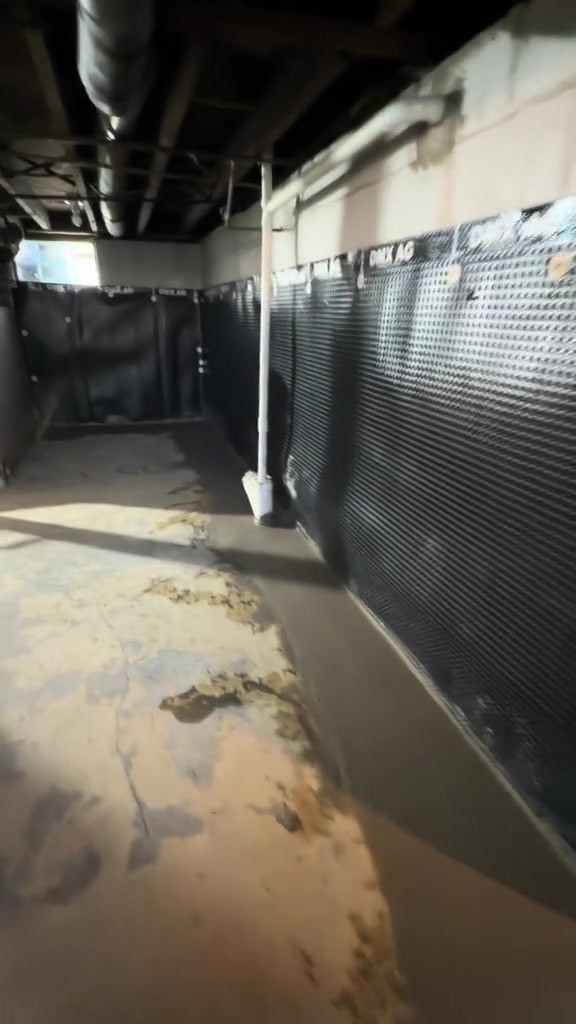
Here is an interior system in an older Mount Clemens home: 108 feet of drain tile and a new sump, with the walls wrapped and tied in. The principle is the same in a Michigan basement, just with more wall repair along the way.
Should you buy a house with a Michigan basement?
Thousands of great old houses in Macomb and Oakland County have one, so do not let it scare you off. Walk it in spring if you can. Look for standing water, a tide line on the walls, mold on the joists above, and rust on the furnace and water heater; those tell you how wet it gets. Check that the mechanicals sit on blocks above the floor. Budget for drainage at minimum, and get a waterproofing contractor (not just the home inspector) to look at the walls before you close. We do these inspections across Southeast Michigan, and a documented drainage system with a transferable warranty is a real selling point when it is your turn to sell.
Frequently asked questions
What is the difference between a Michigan basement and a regular basement?
A Michigan basement was dug under an existing house with stone or rubble walls and a dirt floor, with no drainage designed in. A regular basement was built as part of the house with footings, poured or block walls, a concrete floor and usually a sump.
Why is it called a Michigan basement?
The name comes from how common these dug-out cellars are under Michigan farmhouses. The same thing exists across the Midwest under other names.
Can you finish a Michigan basement?
Rarely, because of headroom and moisture. With drainage and a sump, it can be made dry enough for storage, laundry and mechanicals.
How much does it cost to waterproof a Michigan basement?
It depends on how much wall repair is needed along with the drainage. Interior systems in our area run approximately $6,000 to $8,000 for a 40-foot wall, depending on size and condition; stone wall repair is quoted on top. We give a firm number after seeing it, and estimates are free.
Does a Michigan basement need a sump pump?
Almost always. Without one, any water that comes in has nowhere to go.
Mansour’s Innovations is a family-owned waterproofing, excavation and plumbing contractor in Shelby Township, Michigan, serving Macomb, Oakland and Wayne counties since 2014. Owner Imad “Matt” Mansour has 20+ years in the trade and the crew has completed 1,600+ projects. Our waterproofing work carries a 25-year transferable limited warranty. Call or text (586) 345-7292 for a free estimate.