


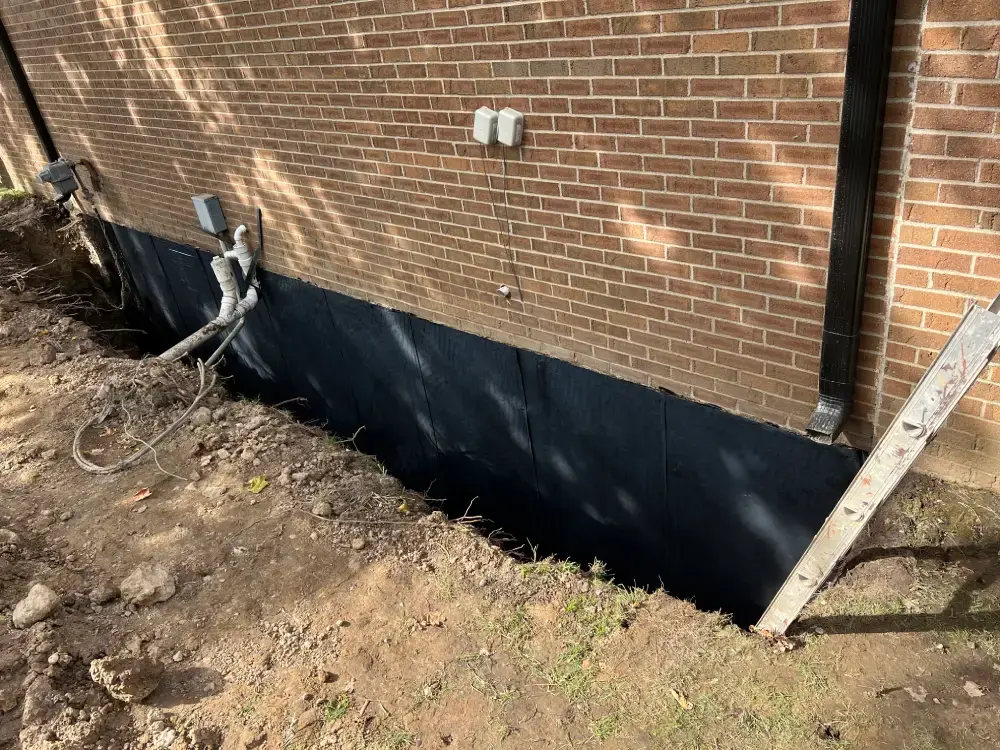
Before anybody quotes you a fix for a leaking basement, they should know what kind of water it is. Groundwater coming through the wall, sewage coming up a floor drain, a pipe leaking inside the wall, and condensation on a cold foundation all look like “water in the basement,” and every one of them has a different fix.
Watch: Why Michigan Basements Leak Every Spring
Read the video transcript
Why do so many Macomb and Oakland County basements leak every spring? It comes down to clay soil and water pressure. Much of Southeast Michigan sits on heavy clay. Clay drains slowly, so when the snow melts and the spring rains come, the ground around your house stays soaked. When a house is built, the hole for the basement gets backfilled with looser soil.
That loose soil soaks up water like a sponge, and the clay around it holds it in, like a bowl. As that water rises, it pushes on the walls and up under the floor. That’s hydrostatic pressure, and it forces water through cracks, form tie holes, and the joint where the wall meets the floor.
Watch for damp spots, white chalky lines on the walls, a musty smell, and water along the floor edges after a big rain. The fix depends on the house. Better grading and downspouts, crack injection, or a drain tile system with a sump pump.
We’re Mansour’s Innovations, based in Shelby Township. We do waterproofing, excavation and plumbing, so we can chase a leak whether it’s coming from the ground, the sewer or the pipes. We’ve worked on basements across Macomb and Oakland counties since 2014.
Where the water usually comes in
Where the wall meets the floor
The most common leak we see. After a heavy rain or a thaw, water builds up under the slab and against the wall, and it comes out along the joint at the bottom. That usually calls for an interior drain tile system and a sump.
Cracks and tie-rod holes
Poured walls leak at specific spots: a vertical crack, or the small holes left by the metal ties that held the forms. Those get injected so the seal goes all the way through the wall. A long horizontal crack is a different story. That wall is being pushed in, and it may need bracing along with the repair.
Window wells and the top of the wall
Water at a basement window usually means the well is full, its drain is clogged, or the downspout above it is dumping straight into it. Those are often small fixes.
Floor drains and sewer backups
If the water comes up through a floor drain, smells, or shows up when the whole street gets heavy rain, it’s a sewer problem, not a wall problem. Many older communities in south Oakland and south Macomb have combined sewers that overload in big storms. A backwater valve stops the city’s sewer from backing into your house.
Plumbing leaks
Water that shows up when nobody’s used a hose and it hasn’t rained is often a supply line, a drain line or a water service leak. We’re plumbers too, so we track those down as well.
What to do right now
- If there’s standing water, keep away from outlets and appliances sitting in it.
- Check that your sump pump is running and its discharge isn’t frozen or clogged.
- Look at your downspouts. One disconnected downspout can put a lot of water next to the wall.
- Take photos of where the water is coming in. It helps us find the source faster.
We answer emergency calls from 8 a.m. to 8 p.m., seven days a week. If the basement is actively flooding, call.
How we find the source
We start by looking at the basement and the outside of the house together, because the leak and its cause are often on opposite sides of the wall. We use moisture readings and, when it helps, a camera down the sewer line or thermal imaging. Then we tell you what we found and what we’d do. If a downspout extension fixes it, we’ll tell you that too.
Where we work
For more on what we see in your area, see our leaking basement pages for Macomb and Oakland.
Questions we get about leaking basements
Why does my basement only leak in spring?
Snowmelt and spring rain saturate the clay around the house when the ground below is still frozen, so the water has nowhere to go but sideways into the foundation. That seasonal pattern usually points to groundwater, not a pipe.
Is a leaking basement covered by insurance?
Groundwater seepage usually isn’t. Sewer backup sometimes is, if you have that coverage. Check your policy, and keep photos either way.
What does it cost to fix?
That depends completely on the source. Some leaks are small fixes. Some need a full system. We give you an exact price after a free look.
Call (586) 345-7292. We book free estimates from 8 a.m. to 8 p.m. every day, emergencies included.