
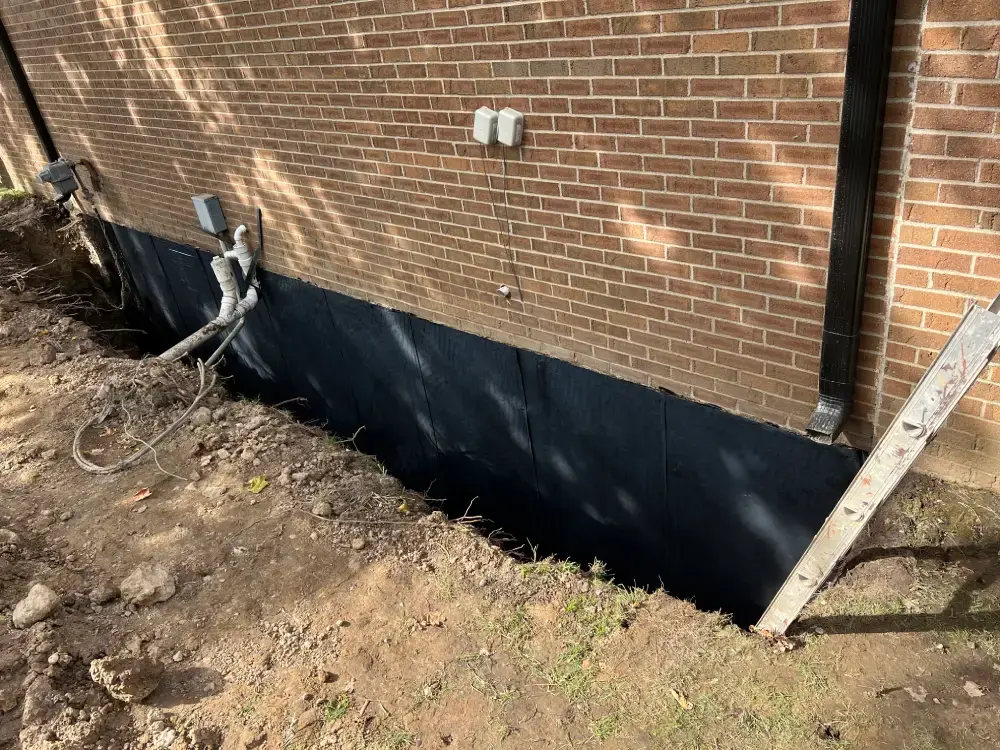
A catch basin is a small box with a grate, set at the low spot where water collects. It takes the water off the surface and feeds it into a buried pipe that carries it away. We install catch basins and the drain lines behind them for homes across Macomb and Oakland County, with our own digging equipment.
When a catch basin is the right fix
- Puddles sit by the house for hours or days after rain
- A low spot in the yard never dries out
- Water runs toward the house and the ground cannot be regraded, because a patio, a walkway or a neighbor’s higher yard is in the way
- The basement wall is damp on the side where the water collects
Water sitting next to a house soaks straight down along the foundation wall. In clay it has nowhere to go, so it builds pressure against the basement and finds every crack. Getting it off the surface is often the cheapest way to keep a basement dry.
Catch basin, French drain or trench drain
- Catch basin: collects water that is sitting on the surface at one low spot
- French drain: a buried trench with perforated pipe and stone that catches water moving through the soil
- Trench drain: a grated channel across a driveway, patio or walkway that catches water running over pavement
A lot of yards need more than one. Small catch basins let surface water get into a French drain, and on a large wet area a network of drains and basins runs to one outlet.
The outlet decides whether it works
A drain is only as good as its outlet. From the basin, solid pipe runs underground to a place that can take the water:
- A lower part of the yard, where the pipe can come out to daylight
- A ditch or a storm sewer, with the city’s permission
- A dry well, where a test hole shows the soil drains
- A drainage basin with a pump, when there is nothing downhill to run to
Much of Macomb and Oakland County is heavy clay, and a dry well in solid clay fills up and stays full. We tell you up front when a dry well will not work and the water needs a piped outlet or a pump.
How we install a catch basin
- We walk the yard, ideally during or after a rain, to see where the water comes from and where it sits
- MISS DIG marks the public utility lines before we dig
- The basin is set at the low spot, and the pipe is trenched to the outlet and pitched so the water keeps moving
- We backfill and put the yard back when we are done
Imad Mansour completed NDS’s Professional Drainage Contractor training and evaluation. You can see and verify the certificate.
A catch basin job in Bloomfield Hills
A Bloomfield Hills home had water pooling against the foundation. We set a catch basin at the low spot where the water collected and ran solid pipe underground across the yard to a dry well, away from the house. It was done in a day. See the Bloomfield Hills catch basin and dry well job.
- Yard Drainage Fix for Heavy Pooling by the Front Door (Michigan), a job video
- Standing Water in Your Yard After Rain: Fixes That Actually Work on Michigan Clay
- How a French Drain Is Built, Step by Step
Permits
Drainage work that discharges to a county drain, a ditch or a storm sewer needs permission, and soil erosion permits apply when enough ground is disturbed near water. We handle Macomb County and local permits as part of the job.
What a catch basin costs
There is no set price for a catch basin. It depends on how far the pipe runs, the yard and what is in the way, and on where the water can go. We price it at a free estimate after we see where the water goes. If the line ends in a dry well, that price is on our dry well installation page.
Catch basins and drain lines are drainage work, not waterproofing, so our 25-year transferable limited warranty does not cover them. Any warranty on drainage work is the one written on your contract or invoice.
Keeping it working
A catch basin needs very little upkeep. Keep the grate clear of leaves, and make sure the outlet is not buried or blocked. If water starts pooling again, call us.
Yard drainage near you
- Yard drains and French drains in Macomb County
- Yard drains and French drains in Oakland County
- Yard drains and French drains in Sterling Heights
- Yard drains and French drains in Clinton Township
- Yard drains and French drains in Warren
- Yard drains and French drains in St. Clair Shores
- Yard drains and French drains in Bloomfield Hills
- Yard drains and French drains in Troy
To have the yard looked at, call (586) 345-7292, 8 AM to 8 PM, 7 days a week, or book a free estimate. All of our yard drainage work is on the yard drainage and French drains page.
Catch basin questions
What is the difference between a catch basin and a French drain?
A catch basin collects water sitting on the surface at a low spot. A French drain is buried and catches water moving through the soil. Many yards use both on one line.
What is the difference between a catch basin and a dry well?
A catch basin is a box at the low spot that collects surface water. A dry well is a buried chamber away from the house that holds that water and lets it soak into the ground slowly.
Where does the water from a catch basin go?
Through solid pipe to a lower part of the yard, to a ditch or storm sewer where the city allows it, to a dry well where the soil drains, or to a basin with a pump when there is nothing downhill.
Will a catch basin work in clay soil?
Yes, because the basin and pipe move the water the clay cannot. What matters is the outlet. A dry well in solid clay fills and stays full, so there the water needs a piped outlet or a pump.
Do catch basins need maintenance?
Very little. Keep the grate clear of leaves and make sure the outlet is not buried or blocked.
How much does a catch basin cost?
It depends on how far the pipe runs, the yard and what is in the way. We price it at a free estimate after we see where the water goes.