


Every hardware store from Gratiot to Van Dyke sells waterproofing paint in five-gallon buckets, and it’s one of the most common things we find on Macomb County basement walls. Usually it’s peeling. Sometimes there are two coats of it, in two different colors, with a white crust pushing through both.
We’re not against sealing walls. On the right wall, for the right problem, a coating is a reasonable fix and costs a lot less than drainage. The trouble is that it gets used on the wrong problem most of the time. This page is about telling the difference.
What a coating can actually stop
A sealer works on the inside face of the wall. It fills the pores in the concrete or block and leaves a film. That’s enough to stop dampness, the kind of slow moisture that wicks through masonry and makes a basement smell musty, leaves a dark band on the lower wall, or keeps a cardboard box on the floor soft. It’s also enough to stop the dust and light efflorescence that comes off unsealed block.
It won’t hold back water that’s under pressure, though. When the soil outside is soaked, water pushes on the wall from the outside in. A coating on the inside face is being pushed off the wall, not into it. It holds for a while, then the water gets behind it in one spot, and the paint blisters and lets go. That’s why a basement painted in the summer often looks fine until the first wet spring, and then peels in sheets along the bottom three feet.
So the useful test is simple. If you’ve never had liquid water on the floor, only damp walls and a smell, a good sealer may be all you need. If water has ever run down the wall or across the floor, a coating is at best a cosmetic layer over a drainage problem.
Block walls in south Macomb and poured walls up north
The houses that went up in Warren, Roseville, Eastpointe and the older parts of Sterling Heights in the 1950s and 60s mostly have concrete block basements. Block is porous, and the hollow cores fill with water during a wet stretch. A sealer on the inside face can slow the moisture that wicks through the block, and it does help with the musty smell and the dust. It can’t do anything about water already inside the cores, which drains down to the bottom course and comes out at the floor no matter what is painted on the face.
That’s the most common reason sealed block walls still leak. The owner sees water at the base of a freshly painted wall and assumes the paint failed. The paint is fine. The water came out underneath it.
Poured walls, the norm in Shelby, Macomb and Chesterfield township subdivisions built from the 1980s on, are much denser. They don’t wick moisture through the face nearly as much, so sealing a poured wall for dampness rarely does much. When a poured wall leaks, it leaks at a specific spot, a crack or a tie-rod hole, and the fix for that is injecting the crack, not painting the wall. If the rest of a poured wall is damp everywhere, look for humidity first. A cold wall in a humid July basement sweats like a glass of iced tea, and that is a dehumidifier problem.
Parging, and the stuff on the outside
Parging is a thin coat of cement mortar troweled over a block wall, usually on the outside. Builders parged the exposed part of the wall above grade to make it look finished, and on some older houses the whole outside of the block was parged and then tarred before backfill. Parging smooths the wall and sheds rain, and that’s about it. It cracks along the mortar joints as the block moves, and it isn’t waterproof on its own. On a lot of 1950s Warren and Roseville houses, the parging above the grass is the only part of the foundation you can see from the street, and it’s usually the first place freeze damage shows.
On the inside, a skim coat of mortar or a cement-based waterproof coating can be a decent fix on a block wall that only seeps a little and has never pushed water onto the floor. Cement coatings bond into the block better than paint does, and they tolerate a damp wall. We’ll use them in that situation. We won’t use them as a substitute for drainage on a wall that floods every April.
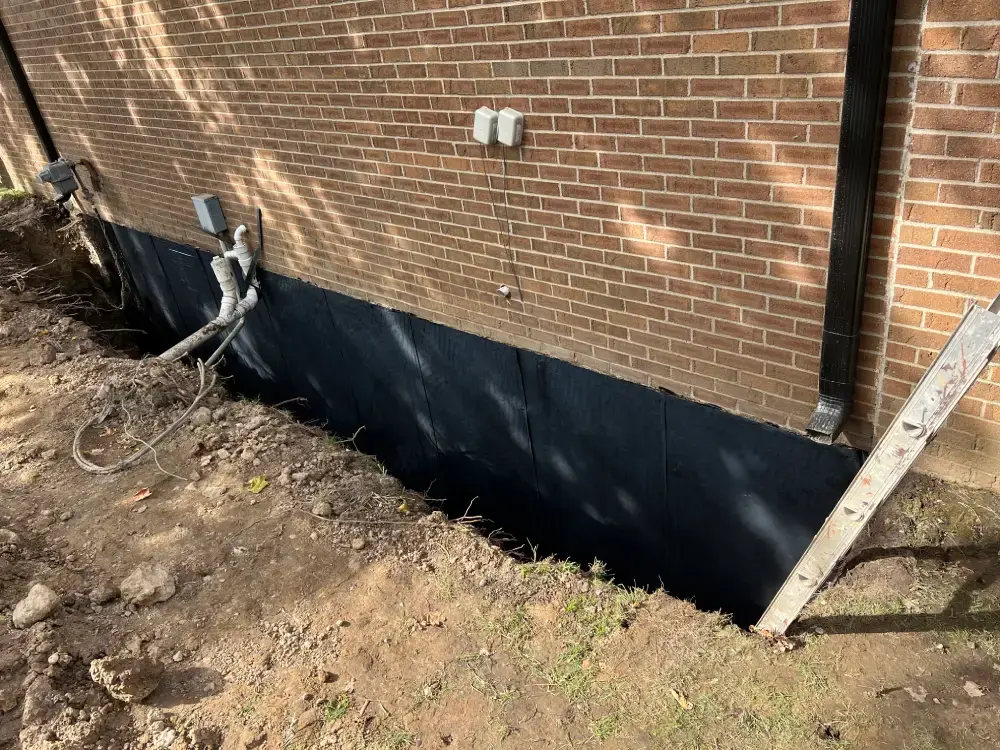
Exterior sealing is a different, much bigger job. When we dig a wall out, we put a real membrane and drainage board on the outside, which is the only coating that sits on the side of the wall the water is actually coming from. That’s covered on our exterior waterproofing page.
How we’d approach your wall
If you call us about sealing, we’ll start with the same walk-through we do for any leak. We look at the wall, the floor joint, the window wells and the grading outside, and we ask whether you’ve ever had standing water. If it’s dampness only, and the outside drains the water away from the house, we’ll recommend a proper masonry sealer or cement coating and tell you how to prep the wall for it. Plenty of homeowners do that themselves on a weekend, and we’ll say so.
If you’ve had water, we’ll show you where it’s coming in and talk about the actual fix. It might be a clogged gutter. It might be a crack, handled on our crack injection page. Sometimes it’s drainage along the wall. Once the water has somewhere to go, sealing the wall for looks and dust is a fine finishing step, and it’s usually the last thing we do, not the first. The estimate is free, from our home base in Shelby Township.
Questions we get about this in Macomb County
Will waterproof paint fix the dampness on our block walls in Warren?
It can help with dampness, meaning a musty smell or a dark band on the wall with no water on the floor. It won’t stop water that collects inside the block cores and runs out at the floor. If you have had water on the floor during heavy rain, paint won’t solve it, and it will likely peel by the next spring.
Why did our sealer peel off the basement wall after one winter in St. Clair Shores?
Water got behind it. When the soil outside stays wet, water pushes through the wall from the outside and lifts the coating off the inside face. Near the lake the ground stays wet longer, especially in high-water years. A peeling sealer is usually a sign that the wall needs drainage, not a better brand of paint.
Our Sterling Heights basement has poured walls and a musty smell but no water. Should we seal them?
Probably not as a first step. Poured walls don’t pass much moisture through the face, so a musty smell in that kind of basement is often humidity, not seepage. Run a dehumidifier for a few weeks and watch the reading. If the walls still show damp patches near the floor, then we’d look for a specific leak.
What is parging, and should we redo ours?
Parging is a thin mortar coat on the outside of a block foundation, mostly on the part you can see above ground. Redo it if it is cracked and falling off, because it protects the block from rain and freeze damage. Don’t expect it to waterproof the wall. It was never meant to.
Can you seal our basement walls before we finish the basement in Chesterfield?
We can, and we’d first make sure the basement has had no water problems. If it’s been dry, a coating on the walls and a vapor barrier behind the framing is a reasonable step before finishing. If there has been any water, fix that first, because finishing over a leak means paying to remove the drywall later.
How long does a sealer last on a Macomb County basement wall?
On a wall that only deals with dampness, a good masonry sealer or cement coating can hold for many years. On a wall that takes water every spring, it might not last one season. The coating’s life depends far more on what’s happening behind the wall than on the product, and we’ll tell you honestly which kind of wall you have.
Recent Macomb Township jobs on video
Real jobs filmed by Imad “Matt” Mansour and the crew – no stock footage. Tap a video to play it with sound.
150 ft Interior Waterproofing Underway in Macomb, MI – Trenching Along the Foundation
See more job videos on our TikTok · Browse our project gallery