


Crawl spaces aren’t the norm in Oakland County, which is exactly why they get ignored. Most houses here have full basements. The crawls we see are under the houses that started life as something else. A lake cottage that got winterized, then expanded, then sold as a year-round home. A family room or a sunroom added onto the back of a 1950s ranch. A kitchen bump-out on a Royal Oak bungalow. Nobody goes down there, and that’s how a crawl gets to the point where the smell comes up the stairs.
Cottage country turned year-round
A century ago, the lakes in the middle of the county were where Detroit and Pontiac went for the summer. Around Cass Lake, Joseph Sawyer had a canal dredged from Dollar Lake to Cass Lake by 1912 and platted the land around them. The area became the city of Keego Harbor in 1955. Old photos show cottages lined up along the Cass Lake shore in the 1910s. Elizabeth Lake in Waterford started as a resort community too. With 1,468 lakes in the county, that story repeats on a lot of shorelines.
Many of those cottages were built on posts or a shallow crawl because nobody planned to live in them in February. Over the decades they got insulation, a furnace, a second story and an addition or two, each one on whatever foundation was cheapest that year. Under some of these houses you can find three different foundations. A block crawl, a section on posts, and a newer poured wall under the addition, all sitting a few feet above a water table that rises and falls with the lake.
What we find when we go down there
Standing water is the obvious one. In a lakeside crawl it often comes up from below in spring rather than in through the walls, and it can sit for weeks in a low spot where the soil was dug out a bit deeper than the rest. In south Oakland clay, it’s usually rain coming in at a low corner and having nowhere to go.
After that, in roughly the order we see them. Wet soil across the whole floor of the crawl. Insulation hanging off the floor framing, heavy with water. White or dark fuzz on the joists and the bottom of the subfloor. And the floor above, a little soft or bouncy, especially near the outside walls.
Why the smell ends up in the kitchen
Warm air rises out of a house through the upper floors and attic, and it gets replaced from below. In a house with a crawl, a good share of that replacement air comes up from the crawl through gaps around pipes, ducts and wiring. Whatever the crawl smells like, the first floor eventually smells like too. If the furnace ducts run through the crawl, it’s even more direct. That’s why the fix starts with the water, not with the smell.
How we waterproof a wet crawl space
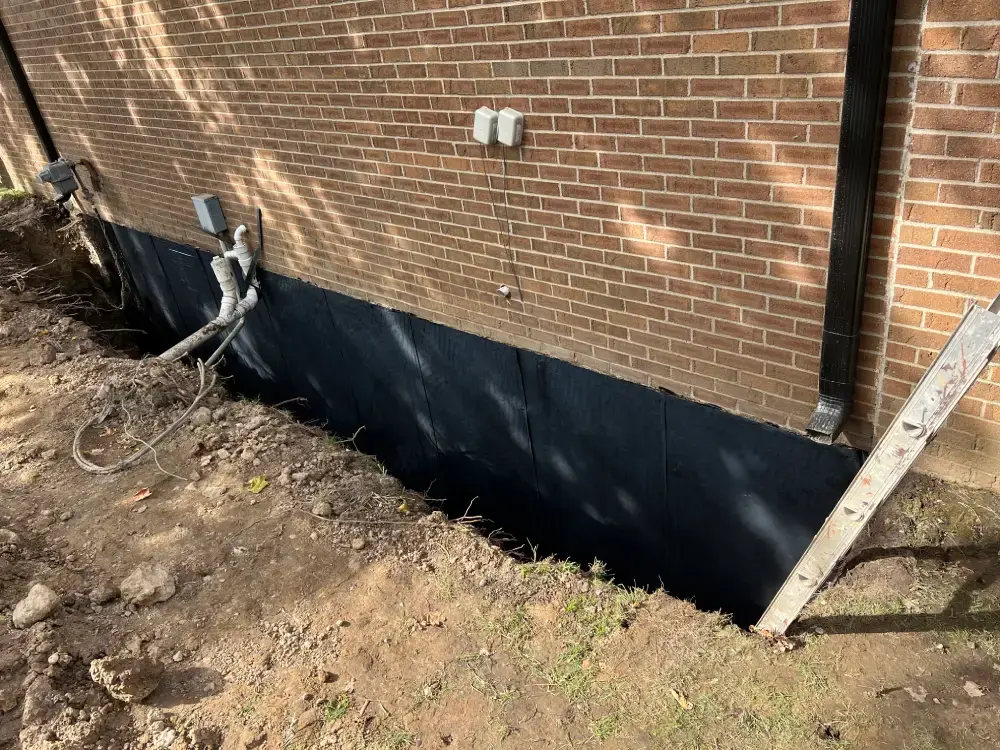
The order matters. First, stop water getting in. Downspouts away from the crawl, the soil outside sloped away, gaps at the top of the wall sealed. If water keeps coming in through the walls, we waterproof the crawl space walls from the outside: dig down along the foundation, seal the wall, cover it with a rubber membrane and dimple board, and lay drain tile in a filter sock at the footing. If water comes up from below, we put a sump pit and pump at the low point of the crawl, the same idea as in a basement but in a space where we’re working on our knees. Near a lake, that pump needs to discharge well away from the house, or it just circulates the same water.
How long the job takes depends on the crawl. Access matters most. A crawl with a full-size hatch and two feet of headroom is a different job from one we reach through a hole cut in a closet floor. We’ll tell you what we expect once we’ve been down there, and the estimate is free.
Sagging floors over a wet crawl
A soft or sagging floor over a crawl almost always traces back to water. A post sitting on wet clay that settled, or a sill or joist end that rotted where it sat on damp block. We’ll show you what we find with photos and a moisture meter. Rotted framing is carpentry, so you’ll want a carpenter for the wood. The one thing that never works is putting new wood back into a crawl that’s still wet. We dry it first by stopping the water, or the repair rots the same way.
If your crawl is under an addition with a basement next to it, the two usually need to be handled together, since water moves between them through the open side. Our sump pump and interior waterproofing pages cover the basement side, and the estimate for both is free.
On the Macomb County side of the line? See crawl space repair in Macomb County.
Questions we get about this in Oakland County
We bought an old Cass Lake cottage that’s been turned into a full-time house. What should we look for in the crawl space?
Start with a flashlight and a look at the floor of the crawl. Standing water or wet soil are the big signs. Then look up at the joists for mold, rot near the outside walls, and insulation hanging down. Cottages on Oakland’s lakes were often expanded in stages, so check whether each section sits on a real foundation.
Our crawl space near Elizabeth Lake has water in it every spring. Is that from the lake?
Often, yes. Around Oakland’s lakes the groundwater rises with the lake level and the spring melt, and a crawl dug below that level will take water from below no matter how good the walls are. The fix is a sump pit and pump at the low point to keep the water below the crawl floor.
Can you put a sump pump in a crawl space?
Yes. A crawl space sump works the same way as one in a basement: a pit at the low point, a pump, and a discharge line that carries the water well away from the house. If water is also coming in through the walls, we waterproof those walls from the outside.
The floor over our crawl space in Royal Oak feels soft near the back wall. Is that a waterproofing problem?
Usually it starts as one. A soft spot near an outside wall over a crawl is often a sill or joist end that’s been sitting on damp block for years. We’ll check moisture levels and look at the wood. Rotted framing needs a carpenter, but if the crawl stays wet, the new wood will rot the same way, so the water comes first.
How long does crawl space waterproofing take?
It depends on the size of the crawl, how much drain it needs, and how we get in. You can stay in the house while we work. We’ll need clear access to the hatch, and if the only way in is through a closet floor, we’ll talk about whether a better hatch is worth adding. We give you a timeframe with the free estimate.
Do you work on crawl spaces out by the lakes in Waterford and West Bloomfield?
Yes. Those are a bit farther from our home base in Shelby Township than our usual eastern Oakland work, but the lake towns are where most of the county’s crawl space trouble is, so we make the trip. We’ll schedule the visit when we can see the crawl at its wettest, which usually means spring.
Recent Oakland County jobs on video
Real jobs filmed by Imad “Matt” Mansour and the crew – no stock footage. Tap a video to play it with sound.
Exterior Waterproofing in Birmingham, MI – Excavation, Membrane, French Drain & Yard Restored
Exterior Waterproofing & Drainage in West Bloomfield, MI – Plugged Drain Found and Replaced
Foundation Crack Repair in Rochester Hills, MI – 38 Rod Holes Packed + Vertical Cracks Sealed
Catch Basin + Dry Well Drainage Fix in Bloomfield Hills, MI – No More Pooling by the Foundation
See more job videos on our TikTok · Browse our project gallery