


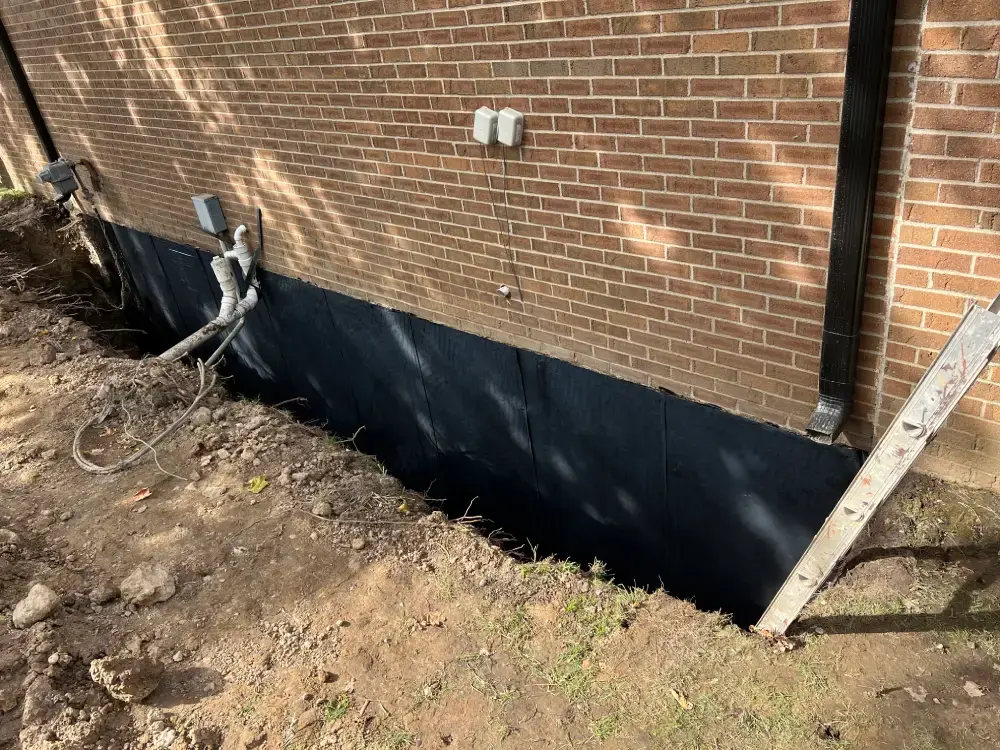
If you ask ten waterproofing people which is better, inside or outside, most will say outside, because it keeps water off the wall instead of managing it after it gets there. On paper that’s right. In a real Oakland County house, with a finished basement, a deck bolted to the back wall and a neighbor’s driveway eight feet from the side, it’s often the wrong job.
This page is about those houses, where interior waterproofing is the better choice even though exterior sounds better, and what we put in when we go that route.
The houses where we go inside on purpose
Finished basements. In Birmingham, Royal Oak and Huntington Woods, a lot of basements have been finished two or three times by different owners. Digging outside doesn’t touch the finished side, which sounds like a plus, but it also doesn’t deal with the water already behind the drywall or in the block cores. And if the problem is water coming up at the floor edge, exterior work on the wall won’t stop it. Interior work means opening the bottom of the walls, but it gets at the actual entry point.
Things built over the footing. Decks, porches, a three-season room, a poured patio, a garage that shares a wall with the basement, an addition on a crawl space. Every one of those sits on or right next to the foundation. Digging outside means taking them apart or tunneling under them, and it’s the single biggest thing that turns a reasonable exterior job into an unreasonable one.
Tight lots. In Berkley, Ferndale and the older blocks of Royal Oak, side yards are narrow and the driveway often runs right along the foundation. There’s no room for an excavator on one side and sometimes not on either. Digging by hand next to a neighbor’s foundation in wet clay is slow and carries its own risks.
Winter. Oakland County footings sit below the frost line, around three and a half feet down plus the basement depth. Getting to them through frozen ground in January is miserable, and backfill that goes in frozen settles badly in spring. Interior work doesn’t care what month it is.
What goes into an interior system
It isn’t just a drain. When we waterproof from inside, the package usually has four parts, and the house decides how much of each.
- A drain at the footing along the walls that need it, running to a pit
- A dimpled membrane on the lower wall, or the full wall when it weeps through the face
- A sump pump with a backup, and a discharge line that leaves the house properly
- A vapor barrier or sealed floor where the slab itself sweats or wicks
How the drain goes in, the saw cut and the trench and the stone, is on our interior drainage system page for Oakland County, so we won’t walk through it again here. The short version is that it’s two or three days, the floor gets a new strip of concrete along the walls, and the yard is never touched.
The wall treatment depends on the wall. A poured wall that’s dry except at a couple of cracks gets those cracks injected and maybe a short membrane at the bottom. A block wall that darkens with every rain gets a full-height membrane, fastened at the top and tucked into the drain at the bottom, so water coming through the block face runs down behind it instead of into the room. We’d put the new framing in front of that, not against the wall.
The vapor barrier piece is the one people forget. A slab poured right on clay with no plastic under it, which describes many basements built before the 1970s, will pull moisture up all year. That’s the musty smell even when there’s no water on the floor. Sealing or covering the slab matters if the room is going to be finished.
Why interior can be the better system, not just the easier one
In the flat clay south of the hills, water doesn’t arrive at your wall from the side the way it does on a slope. It rises. The groundwater sits a few feet below grade and comes up to meet the footing during a wet stretch. A membrane on the outside of the wall stops water from coming through the wall. It doesn’t stop water from coming up between the wall and the floor, or through the floor. An interior drain at the footing relieves the water at the level it actually sits, which in that soil is the problem.
In June 2021, a lot of people in the southwest corner of Bloomfield Township got more than four inches in one night. In a night like that on clay, what keeps a basement dry (sewer backups aside) is a footing drain that moves water and a pump that keeps up. A membrane on the outside of the wall with nothing draining the footing won’t carry you through it.
When we’d still tell you to dig outside
A block wall that’s bowing in and needs to be straightened or reinforced from the soil side. A stone or clay tile foundation that’s crumbling. A walkout on a slope where all the water comes downhill at one buried wall. A wall that’s behind something inside you can’t move, like a poured concrete stair. For those, our exterior waterproofing page covers the dig.
And if your water came in through the floor drain, neither one is the fix. That’s a backwater valve.
The finished-basement question
If you’re about to finish a basement, waterproof first, even if it’s only been wet once. Opening a finished wall to fix a leak later costs far more than doing it with the studs out. If the basement is already finished, we take off only what we have to, usually the bottom two feet of drywall along the affected walls, and we leave a clean edge for your drywall person to patch.
Call (586) 345-7292 for a free estimate. We’ll look at what’s on both sides of the wall before we recommend anything.
Questions we get about this in Oakland County
Our Birmingham basement is finished. Wouldn’t exterior waterproofing let us leave it alone?
It would leave the inside alone, but it won’t help if the water is coming up at the floor edge or is already in the block cores. Exterior work also means digging next to the house and whatever landscaping and hardscape is there. In most finished basements we see, taking off the bottom two feet of drywall and going in from inside is the less disruptive job overall.
We have a big deck along the back of our Rochester Hills house. Does that rule out exterior work?
It makes exterior work on that wall much harder. The deck has to come off or the crew has to dig under it by hand, and the footings for the deck posts are often right in the way. Unless the wall itself needs structural work, we’d waterproof that wall from inside and save the deck.
Can interior waterproofing be done in January in Oakland County?
Yes, and winter is a perfectly good time for it. Everything happens in the basement, so frozen ground and snow don’t matter. The only outside work is where the discharge line leaves the house, and we can do that in any weather.
Is an interior system a real fix on south Oakland clay, or just a workaround?
On flat clay it’s a real fix. Groundwater there rises to meet the footing rather than pouring down from the side, and an interior drain catches it at the footing. That’s why it holds up in long wet springs. The one thing it won’t do is stop a sewer backup through a floor drain.
Our Royal Oak house is about eight feet from the neighbor’s. Can you even dig on that side?
Usually not with a machine, and digging by hand right next to someone else’s foundation in wet clay is risky for both houses. For that wall we’d almost always recommend going inside. If it’s the only wall leaking, that keeps the job small too.
We plan to finish our basement in West Bloomfield this year. Should we waterproof first?
Yes, if there’s been any water at all. With the studs out, the job is faster and nothing gets torn out later. We’d put the drain and membrane in first, then you frame in front of the membrane with a small gap so the wall stays dry.
What part of the interior system does the 25-year transferable limited warranty cover?
Our workmanship on the drain tile and membrane we install, for 25 years, and the coverage can transfer if you sell. The sump pit and pump are not covered by it. The pump itself carries its manufacturer’s warranty. If water gets past the system where we worked because of our workmanship, we come back and fix it.
Recent Oakland County jobs on video
Real jobs filmed by Imad “Matt” Mansour and the crew – no stock footage. Tap a video to play it with sound.
Exterior Waterproofing in Birmingham, MI – Excavation, Membrane, French Drain & Yard Restored
Exterior Waterproofing & Drainage in West Bloomfield, MI – Plugged Drain Found and Replaced
Foundation Crack Repair in Rochester Hills, MI – 38 Rod Holes Packed + Vertical Cracks Sealed
Catch Basin + Dry Well Drainage Fix in Bloomfield Hills, MI – No More Pooling by the Foundation
See more job videos on our TikTok · Browse our project gallery