


Updated
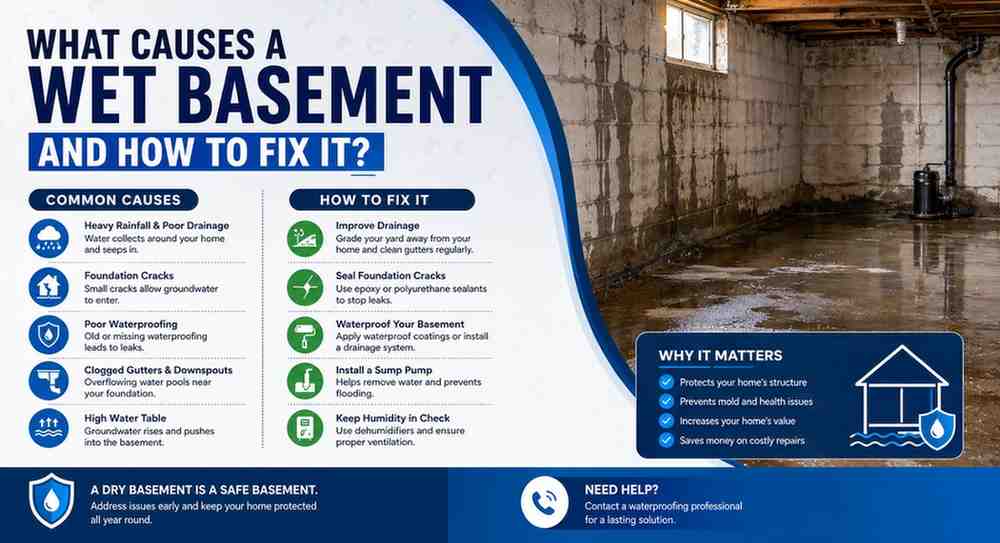
A wet basement almost always comes down to one of a handful of causes. The fix depends entirely on which one it is, so here they are, with what actually fixes each.
| Cause | What you see | The fix |
|---|---|---|
| Roof water dumped at the foundation | Water near one corner after rain | Downspout extensions, gutter cleaning |
| Soil sloping toward the house | Water along one wall, soggy ground outside | Regrading, sometimes a French drain |
| Hydrostatic pressure under the floor | Water at the wall-floor joint after storms or thaw | Interior drain tile and a sump |
| Failed old drain tile | A basement that was dry for years starts leaking | New drain tile, inside or out |
| Leaking cracks or tie-rod holes | Water at specific spots on a poured wall | Crack injection |
| Water trapped in block walls | Damp lower blocks, white powder, peeling paint | Weep holes and an interior drain |
| Window wells | Water at a basement window | Clearing or adding a well drain, a cover, regrading |
| Sump pump failure or power outage | Sudden flooding during a storm | Pump replacement, a battery or water-powered backup |
| Sewer backup | Water or sewage up the floor drain | Backwater valve |
| Plumbing leak | Water with no rain, near pipes or fixtures | Plumbing repair |
| Condensation | Damp walls and a musty smell in summer | Dehumidifier and air movement |
Why Southeast Michigan basements are prone to it
Heavy clay soil holds water against foundations instead of letting it drain. Freeze and thaw cycles push on walls. Spring snowmelt arrives while the ground below is still frozen. And many older neighborhoods have combined sewers that overload in big storms.
Start with the cheap stuff
Downspouts, gutters and grading fix more wet basements than people expect. If water still comes in after the next big rain, the cause is in the foundation itself.
What the bigger fixes cost
Interior waterproofing runs approximately $4,500 to $8,000 for about 40 linear feet of wall, not including the sump, exterior approximately $6,000 to $12,000 for about 40 linear feet of wall, and crack injection approximately $500 to $600 for a small crack and $1,500 for a full-height crack ($2,000 if it was filled or repaired before). A sump pump system adds approximately $2,500 to $3,000. A full basement done from the inside is priced by its total linear footage; a large one (about 250 linear feet, with one or two sump systems) can run up to approximately $35,000. A full basement done from the outside is priced by its total linear footage and can run up to approximately $60,000, depending on the basement and the property. Contact us for accurate pricing. We have to inspect the job before we can give you a price. See our cost guide.
More on wet basement solutions.
We’re Mansour’s Innovations, a waterproofing, excavation and plumbing contractor in Shelby Township, in business since 2014 and working across Macomb and Oakland counties. Call (586) 345-7292 for a free estimate. We answer calls from 8 a.m. to 8 p.m., seven days a week.
If you are not sure which trade handles your leak, read water in the basement: who to call.
Frequently Asked Questions
1. What causes a wet basement in Michigan?
Most wet basements here come from one of a few sources: hydrostatic pressure from our heavy clay holding water against the foundation, cracks in poured or block walls, a failed or undersized sump pump, poor grading and downspouts dumping next to the house, or a sewer backup. The fix depends on which one it is, so we find the source first.
2. How do you fix a wet basement for good?
By managing the water, not just coating over it. Depending on the cause that means interior drain tile and a sump pump, exterior excavation with a membrane and drain tile, epoxy injection for leaking cracks, or better grading and drainage outside. Paint-on sealers do not hold back water under pressure.
3. Is a little water in the basement normal?
A dry basement is the goal. Occasional minor dampness after a heavy storm can be a grading or humidity issue, but standing water, water at the wall-floor joint, or water through a crack means something needs fixing before it gets worse.