


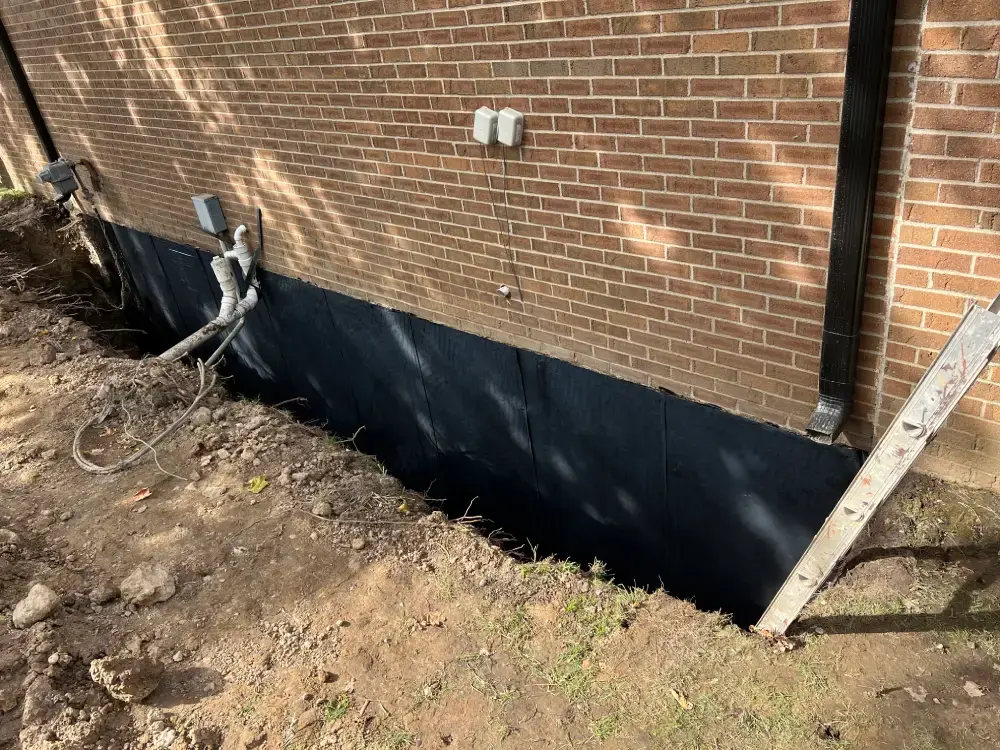
Most crack repair advice you’ll find online assumes a poured concrete wall. That’s a fair assumption in Canton. It’s the wrong one for most of the Wayne County basements we go into, which sit under brick houses built between the 1920s and the 1950s in the Grosse Pointes, Harper Woods, east Dearborn, Redford and the older blocks of Dearborn Heights.
Those walls are made of pieces. Brick laid in lime mortar, concrete block, or hollow clay tile, and sometimes two of those stacked on top of each other. A crack in a wall made of pieces doesn’t behave like a crack in a solid pour, and a fair amount of what gets sold as crack repair in this county is a poured-wall fix applied to a wall it was never meant for.
What a crack looks like in a wall made of pieces
In block and brick, a crack almost never runs straight through the units. It follows the mortar, dropping a course at a time, which is why everyone calls it a stair-step crack. The mortar is the weakest part of the wall, and it’s supposed to be. When the clay outside swells in a wet April and shrinks in a dry August, the wall shifts a hair, and the joints take the hit.
A thin stair-step crack that has been there for years, isn’t wider at one end and doesn’t leak is mostly a mortar problem. We’d repoint it and keep an eye on it. A stair-step crack that’s wider at the top than at the bottom, or that has slipped so the blocks above no longer line up with the blocks below, is telling you something moved. That’s a structural conversation.
The one we take most seriously is a long horizontal crack in block, usually a course or two below the outside grade, on the side of the house that gets the most water. Wet clay leaning on a block wall for sixty years will eventually bend it along a mortar joint. Hold a level against the wall. If it’s out of plumb more than a little, the wall needs bracing or rebuilding, and filling the crack would just hide the evidence.
Hollow clay tile is its own problem
Clay tile foundations turn up under a lot of houses from the 1910s and 1920s, especially on Detroit’s east side and in the inner suburbs. The units are fired clay with hollow cells, often with a ribbed face, and they were never fired hard enough to sit in wet ground forever. When they fail, the face shells off and you can see straight into the cells.
You can’t inject that. There’s nothing for the resin to grab, and the cells just swallow it. A cracked or shelled tile gets cut out and replaced, or the section gets rebuilt in block, and the water that wore it down has to be dealt with in the same job.
Injection works on poured walls, so that’s where we use it
Poured concrete is where crack injection earns its keep. Canton had around 5,000 people in 1960 and tens of thousands more by 1980, most of them arriving after I-275 opened in the mid-1970s, and the houses built from that point on sit on poured walls. Those walls crack in predictable places. Vertical shrinkage cracks running from the corner of a basement window, rusted tie-rod holes, and the cold joint where one truckload of concrete met the next.
For a crack that leaks but isn’t moving, we inject epoxy. It fills the crack all the way through to the soil side and cures stronger than the concrete around it, so the wall acts as one piece again. We don’t inject a crack that’s still opening, because the wall would simply crack an inch to the side. A wall that’s still moving needs bracing first.
A typical poured-wall injection takes a couple of hours from inside, no digging and no jackhammer. The ports come off the next day and you’re left with a gray stripe on the wall. If that’s all your basement needs, that’s all we’ll do. The method is laid out on our crack injection page.
Tuck-pointing, and when it’s actually the fix
On brick and block, the repair for most cracks is tuck-pointing, which means raking the old mortar out of the joints and packing new mortar in. On a 1920s brick foundation the mix matters more than people think. Old walls were laid in soft lime mortar. Pack hard modern mortar into them and the joints end up harder than the brick, so the next bit of movement cracks the brick itself. We use a softer mix on old brick and save the strong stuff for block.
Tuck-pointing fixes the crack. It doesn’t always fix the water. A block wall in a Redford ranch can be repointed beautifully and still weep through the face of the block every April, because the hollow cores fill up and the water comes out wherever it can. Redford had under 7,000 people in 1940 and over 71,000 by 1960, and nearly every house from that rush sits on block. We run into this exact situation there all the time.
When a crack is really a water problem
There’s a pattern we see on the east side constantly. Someone calls about a crack because they found water at the base of the wall after a storm. We look, and the crack is dry and old. The water came up through the floor drain, or in at the joint where the wall meets the floor. In the Pointes and much of Dearborn, the sewer is at least as likely a source as the wall, and our Wayne County page explains why. Sealing that crack would make you feel better and change nothing.
So we always ask when the water shows up. Water running down the face of a crack during a rain, or the day after, is coming through the crack. Water along the whole bottom of a wall is groundwater under pressure, and the crack is a side note. Water rising from the drain, sometimes gray and smelling like it, is the sewer.
What we’d tell you to do about your crack
- A hairline that’s dry and not growing gets a pencil mark at each end and a date. Look again next spring.
- A poured-wall crack that leaks but isn’t moving gets epoxy injection.
- A thin, old stair-step crack in block or brick gets repointed and watched.
- A stair-step crack that has shifted, or a horizontal crack with a bow, needs a structural look before anything else.
- Shelled or broken clay tile gets replaced, along with whatever is soaking it.
A crack in old masonry is also a report on the ground outside. If the wall is moving, something is pushing on it, usually saturated clay fed by a downspout that empties right at the foundation. Fix the crack without fixing that and you’ll pay for the same repair twice. We’ll tell you which situation you have, and the estimate is free at (586) 345-7292.
Questions we get about this in Wayne County
Our 1925 house in Grosse Pointe Park has a crack stepping down the foundation wall. Should we be worried?
Probably not by itself. Stair-step cracks in brick and block follow the mortar joints, and most houses that age have a few. What matters is whether it’s growing, whether the bricks on either side have slipped out of line, and whether it leaks. A thin, dry, old stair-step crack usually just gets repointed. One that’s widening or offset needs a closer look at what’s pushing on that wall.
Can you inject the cracks in a clay tile foundation?
No, and we’d be wasting your money if we tried. Injection resin needs a solid crack with two faces to bond to. Clay tile is hollow, so the resin disappears into the cells. Cracked or shelled tiles get cut out and replaced, or the damaged section gets rebuilt in block. We pair that with fixing the water that broke the tile down in the first place.
We bought a 1990s colonial in Canton and the poured walls have a few vertical cracks. Is that normal?
Yes, mostly. Poured walls shrink as they cure and nearly all of them crack in the first few years, often from the corners of the basement windows. If they’re dry, pencil-mark the ends and leave them. If one leaks in spring, epoxy injection from inside fixes it in a couple of hours with no digging. The south side of Canton drains to the Lower Rouge and Pine Creek, and wet springs there find every crack.
Our Redford basement is block, and one wall has a long crack along a mortar line about halfway up. What does that mean?
A horizontal crack in a block wall is the one we never wave off. It usually means wet clay outside has been pushing the wall in, and the wall is starting to bend at that joint. Hold a level or a long straightedge against it. If the wall bows, it needs bracing or a partial rebuild, and the drainage outside needs work so the pressure drops. Filling the crack alone does nothing.
Should we hire a mason for tuck-pointing instead of a waterproofing company?
For a brick foundation that’s dry and only needs its joints repointed, a good mason is a fine choice, and we’ll say so. We’re the better call when the cracks and the water are tangled together, like a block wall that weeps every spring or a joint that keeps reopening because a downspout dumps against it. Then the repointing is one piece of a bigger fix.
How long does crack repair take, and will you dig up the yard?
A poured-wall injection is usually two or three hours from inside, with no digging. Repointing a section of brick or block is often a day. Rebuilding a stretch of broken clay tile or a bowed block wall is a bigger job that can run several days and sometimes needs excavation outside. On a Dearborn or Pointes lot with a shared driveway, we plan any digging around your neighbor’s access.
Will you drive down from Shelby Township for one crack?
Yes. The Pointes and Harper Woods are usually 35 to 45 minutes from our home base, and Livonia, Dearborn and Canton take a little longer. Some of those visits end with us telling you it’s a hairline you can ignore. That’s a perfectly good outcome, and the visit is free either way.
Watch recent crack injection jobs
Real jobs filmed by Imad “Matt” Mansour and the crew – no stock footage. Tap a video to play it with sound.
Foundation Crack Repair in Rochester Hills, MI – 38 Rod Holes Packed + Vertical Cracks Sealed
Active Foundation Crack Leak Stopped in 1 Hour – Rochester Hills, MI
Multiple Foundation Cracks Repaired in Washington Township, MI – Leaking & Preventive Injection
Vertical Foundation Crack + 6 Rod Holes Sealed – Rochester Hills, MI
See more job videos on our TikTok · Browse our project gallery