


Most of the Wayne County basements we waterproof get done from inside. That isn’t because inside is the easy option. It’s because on a brick house built between the wars, on a narrow lot, with a sewer that can push back up through the floor, the inside package deals with more of the real problems than a dig would.
This page is about that package on old masonry walls. What goes in, how it meets a brick or tile wall, and why the floor drain belongs in the same conversation.
Drain tile against a brick or tile wall
We cut the floor about a foot out from the wall, dig down to the footing, and lay perforated pipe in clean stone along it, pitched toward a sump. On a poured wall that’s most of the job. On brick, block and clay tile, the wall seeps across its whole face rather than at one crack, so where the water comes out matters as much as where it gets collected.
On block we drill weep holes in the bottom course so the water sitting in the hollow cores drains into the stone instead of building up. Brick has no cores, so water works through the mortar and runs down the face. Clay tile is the trickiest of the three. The cells hold water, and the bottom units are often soft from decades of sitting wet. We check that bottom course before deciding how close to the footing we can cut.
Everything that comes out of the trench leaves in buckets, through the side door or a basement window, because there’s no other way out of most of these basements. On a full perimeter that’s a lot of wet clay and broken concrete. We also pick the sump location early, ideally near the wall closest to where the discharge can reach the yard, and away from the furnace and laundry so the pit stays reachable.
Old footings aren’t always what you’d expect
On prewar houses the footing can be narrow, stepped, or just a wider course of brick. Sometimes the original builder poured the floor right up onto it. We find out in the first few feet of trench and adjust. What we won’t do is dig below an old footing to make a standard detail fit. Undermining a 1920s footing to lay pipe is a good way to trade a wet basement for a settling wall.
The membrane on the wall
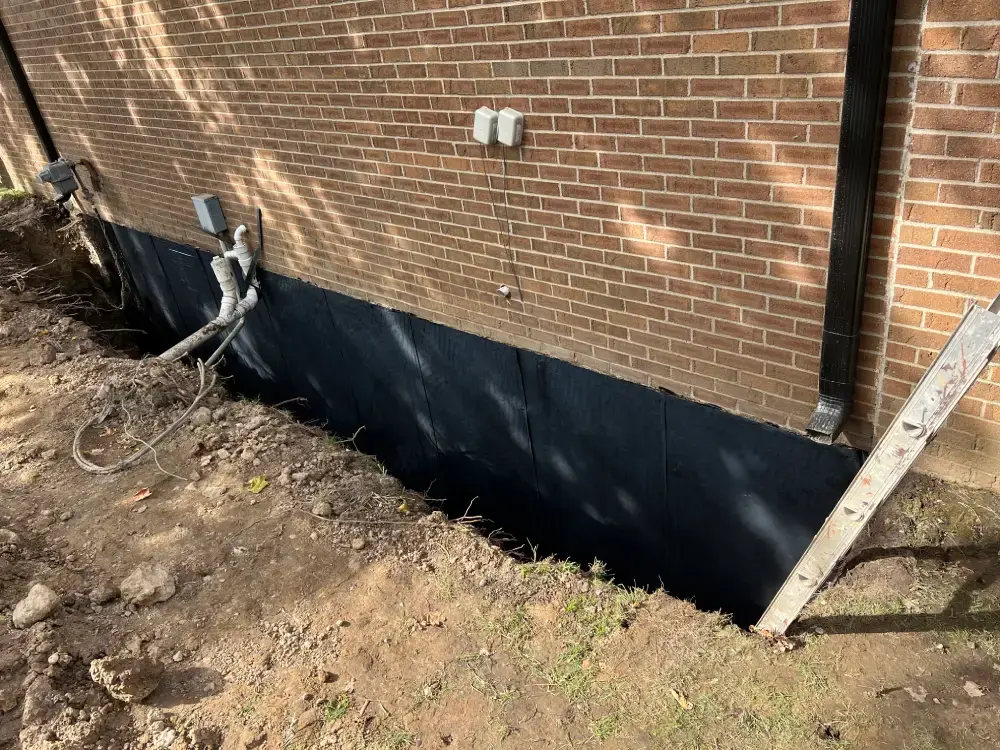
Over the wall goes a dimpled plastic membrane that tucks down behind the new drain tile. Water coming through the brick or tile runs down the back of it into the stone instead of across your floor. The air gap lets the masonry dry, and the membrane keeps the wall’s dampness off whatever you put in front of it later. On a wall that sheds white powder, which describes most old masonry here, a painted coating would just pop off. The membrane doesn’t care.
If you plan to finish the basement, the framing goes in front of the membrane. If you’d rather leave the walls open, some people paint the exposed brick above the membrane for looks, which is fine as long as nobody’s counting on the paint to keep water out.
The sump, and the night the power goes out
The drain tile feeds a sealed sump pit with a pump, a check valve, and a discharge line out to the yard. On these jobs we put in a backup every time, battery or water-powered depending on the house. The storms that fill Wayne County basements are the same storms that knock out power, and losing the pump halfway through one undoes everything else. A water-powered backup runs off city water pressure and has no battery to run down. More on the options is on our sump pump page.
Why the backwater valve belongs in the same job
Dearborn’s sewers are designed for about three inches of rain in 24 hours, and in late June 2021 the city got more than seven and a half. The worst of it landed in the northeast and southeast neighborhoods, which sit lower than the west side and are built on clay, and where more than 70 percent of the houses around Fordson and Salina went up before 1960. Reports put the number of flooded Dearborn homes as high as 8,000, and a large share of that water came up through floor drains, not through walls.
Interior drain tile does nothing about water coming up a drain. It can even make things worse if the old clay footing tile outside still runs to the sewer, because a surge can push sewer water back through that tile and into the stone bed we just laid. So on older houses we treat the backwater valve as part of the interior job. Camera the lateral, cut any footing or downspout connections to the sewer, then set the valve. The sump discharges outside, never to the sewer, so when the valve closes in a storm the pump keeps working.
What the floor looks like after, and how long it takes
The trench gets poured back with new concrete flush to the old floor, leaving a strip about a foot wide along the walls we worked on. A full perimeter in a typical Pointes or Dearborn basement takes three to four days, a single wall a day or two. It’s dusty the first day while we cut, so we hang plastic and run air scrubbers.
Winter is no obstacle, which is another reason the inside approach suits older houses here. Nothing outside has to thaw, and a system installed in January is working before the spring melt. Our drain tile and membrane work on every interior system carries our 25-year transferable limited warranty.
Questions we get about this in Wayne County
Our Grosse Pointe Farms basement leaks along every wall and backed up through the drain in 2021. Where do we start?
With the sewer, then the walls. We’d camera the lateral, find out whether your footing tile or downspouts tie into it, and plan a backwater valve. Then interior drain tile along the walls, feeding a sump that discharges to the yard. Doing the walls first and leaving the drain unprotected is how people end up with a brand-new system and sewage sitting on top of it.
Can interior drain tile go in next to a clay tile foundation wall?
Yes, with care. We check the bottom units first, because tile near the footing is often soft or cracked from decades of standing wet. We cut the trench without undermining the footing, let the bottom course drain, and put a membrane up the wall. If the tile is badly broken, those units get replaced before the system goes in.
Is the interior package any different for a 1950s Westland ranch with block walls?
A little. Block has hollow cores that fill with water, so we drill weep holes in the bottom course to drain them into the new tile, which brick and clay tile don’t need. Houses near the Middle Rouge in Westland also tend to run their sumps hard every spring, so we pay closer attention to pump size and the backup.
Does a water-powered backup sump work in Dearborn?
It works anywhere with city water, Dearborn included, because it runs on municipal water pressure. It’s a good match for long outages since there’s no battery to drain. It does use a fair amount of water while running and needs a backflow preventer on the supply line. Battery backups make more sense where pressure is low or you’d rather not tie into the water supply.
Will the system still work if we finish the basement later?
Yes, that’s one of the reasons people choose it. The membrane goes on first and the framing goes in front of it, so drywall never touches damp masonry. Leave an access panel for the sump and the backwater valve cleanout. In older Pointes houses with low ceilings, we also talk through where the sump sits so it doesn’t land in the middle of a future room.
Can you do interior waterproofing in January?
Yes. Nothing about the inside job depends on the ground outside except the short discharge run, which can sit above grade temporarily and be buried in spring. Winter is often easier to schedule, and it means you’re covered before the spring thaw and the summer storms that do most of the damage around here.
Is interior waterproofing a lesser fix than digging outside?
Not on most older houses in Wayne County. Outside keeps water off the wall, inside catches it and moves it out, and both end with a dry floor. Inside also gets to the floor joint and the sewer connection, which an exterior dig never touches. We lean toward exterior mainly when a tile wall is failing from the soil side or a finished room can’t be opened.
Recent Wayne County jobs on video
Real jobs filmed by Imad “Matt” Mansour and the crew – no stock footage. Tap a video to play it with sound.
Underground Sewer Line Repair in Detroit, MI
Crumbled Catch Basin Rebuilt at Wayne State University, Downtown Detroit
Hydro Jetting + Sewer Camera Scope at a Commercial Plaza in Livonia, MI
See more job videos on our TikTok · Browse our project gallery